





What's Happening?
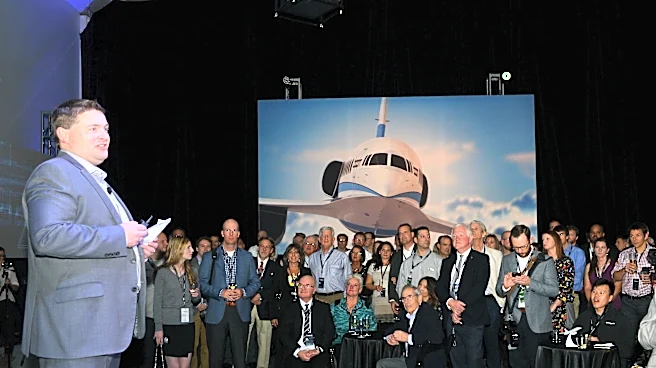
The Air Charter Association (ACA) recently held its annual Broker & Operator Forum in London, where the impact of Artificial Intelligence (AI) on the air charter industry was a central topic. A survey conducted during the event revealed that 79% of attendees
are already utilizing AI in their broking or sales processes. Despite this rapid adoption, 67% of participants believe that the rise of AI will actually increase the demand for a 'personal, trusted service.' Trust was identified as the single most important value a broker provides for clients. The discussions assessed how the role of charter brokers might evolve as AI tools become more widely used, emphasizing the enduring importance of human connection and reliability in a technologically advancing sector.
Why It's Important?
This finding is significant for the U.S. business aviation sector and other service-oriented industries. It suggests that while AI can streamline operations and enhance efficiency, it cannot fully replace the human element, particularly in high-value, relationship-driven services where trust is paramount. For air charter brokers, the ability to build and maintain client trust through personalized service, nuanced understanding of client needs, and reliable execution remains a key differentiator. Over-reliance on AI without preserving this human touch could lead to a commoditization of services and a loss of competitive advantage. This trend underscores the need for businesses to strategically integrate AI as a supportive tool rather than a complete substitute for human interaction, especially in sectors where client relationships are critical to success.
What's Next?
Air charter brokers and other service providers will likely focus on a hybrid approach, leveraging AI for tasks such as data analysis, market research, and initial client matching, while dedicating human resources to relationship building, complex problem-solving, and personalized client interactions. This could involve training brokers to effectively use AI tools to enhance their service delivery, rather than being replaced by them. The industry may also see an increased emphasis on transparency regarding AI usage, ensuring clients understand how technology is being employed to improve their experience without compromising the personal touch. Ultimately, the goal will be to find the optimal balance between AI-driven efficiency and human-centric trust to meet evolving client expectations.
Beyond the Headlines
The forum's conclusions reflect a broader societal discussion about the future of work in an AI-driven economy. It highlights that professions requiring high levels of trust, empathy, and complex interpersonal skills are likely to be augmented, rather than automated, by AI. This could lead to a re-skilling of the workforce, where human professionals focus on higher-order tasks that leverage their unique human capabilities, while AI handles more routine or data-intensive functions. The air charter industry's experience could serve as a case study for other sectors grappling with AI integration, demonstrating that the value of human connection and trust remains resilient even in the face of advanced technological disruption. This also raises questions about how trust is built and maintained in an increasingly digital and AI-mediated world.