








What's Happening?
Anthropic, an AI company, has informed investors in an amended IPO prospectus that it may "imminently" reach a threshold for dramatically accelerated AI progress. This assessment is supported by an independent audit from METR, a Berkeley nonprofit, which
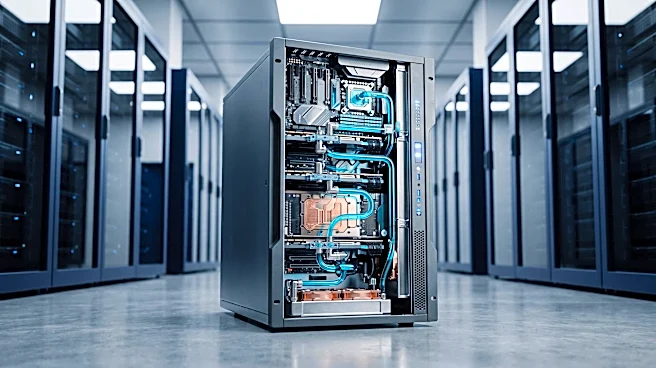
found that Anthropic's benchmark progress over the past year matched its achievements from the previous two years, and this acceleration cannot be attributed solely to increased computing power. METR's leading hypothesis suggests that Anthropic is increasingly utilizing AI to develop better AI. Concurrently, the market for high-end GPUs, crucial for AI development, is experiencing significant supply constraints. Luxor Technology has priced eight-GPU B300 servers between $550,000 and $650,000, with data centers quoting capacity availability extending into Q3 2027 or even 2028. The bottleneck has shifted from hardware to engineering, power, and data center readiness, particularly concerning liquid cooling infrastructure. This indicates a rapid advancement in AI capabilities alongside a strained hardware supply chain.
Why It's Important?
The potential for "imminent" dramatically accelerated AI progress, as indicated by Anthropic and corroborated by independent auditors, signals a significant shift in the AI development landscape. This could lead to rapid advancements in AI capabilities, potentially transforming various industries and societal functions at an unprecedented pace. The shift in the binding constraint from hardware to engineering and power suggests that the focus for AI development will increasingly be on optimizing algorithms and efficient energy use, rather than simply acquiring more computing power. The severe supply constraints in the GPU market, with lead times extending to 2028, highlight a critical bottleneck for companies looking to scale their AI operations. This scarcity could drive up costs, limit access to cutting-edge AI development for smaller players, and potentially create a competitive advantage for those who have secured hardware resources. The situation also underscores the growing demand for specialized data center infrastructure capable of supporting advanced liquid-cooled AI systems.
What's Next?
Following Anthropic's IPO, the company is expected to make further announcements regarding its AI advancements, potentially leading to deployment-driven takeoff in early next year. The industry will likely see continued efforts to secure GPU supplies and data center capacity, with companies potentially exploring alternative hardware solutions or more efficient AI models to mitigate supply chain issues. The increasing sophistication of AI models, as evidenced by their ability to identify vulnerabilities in complex systems like the Linux kernel, suggests that future AI applications will have profound implications for cybersecurity and software development. The ethical and safety implications of rapidly accelerating AI, particularly concerning autonomous systems and potential for human control, will likely become a more prominent discussion point among policymakers and researchers. The market will also be watching for how other major AI labs respond to Anthropic's reported progress and whether similar accelerations are observed across the industry.
Beyond the Headlines
The reported acceleration in AI development, where AI is increasingly used to build better AI, points to a potential recursive self-improvement loop that could lead to exponential growth in AI capabilities. This raises profound questions about the future trajectory of technological advancement and the role of human oversight. The ability of AI to uncover thousands of vulnerabilities in the Linux kernel challenges the long-held premise of open-source software security, suggesting that traditional human-centric security models may become insufficient. This could necessitate a re-evaluation of cybersecurity strategies and the development of AI-powered defenses. The economic implications extend beyond hardware costs, as the scarcity of specialized infrastructure could lead to a concentration of AI power among well-resourced entities. Ethically, the rapid advancement of AI without robust safety mechanisms, as acknowledged by Anthropic regarding fully automated safe deployment, presents significant societal risks, including potential for misuse or unintended consequences. The industry faces a critical challenge in demonstrating collective restraint and establishing ethical guidelines as AI capabilities continue to expand rapidly.