






What's Happening?
Orvana Minerals Corp. has released its financial and operational results for fiscal year 2026, ending September 30, 2026, alongside its guidance for fiscal year 2027 for its Spanish and Bolivian subsidiaries, Orovalle Minerals, S.L. and Empresa Minera Paitití,
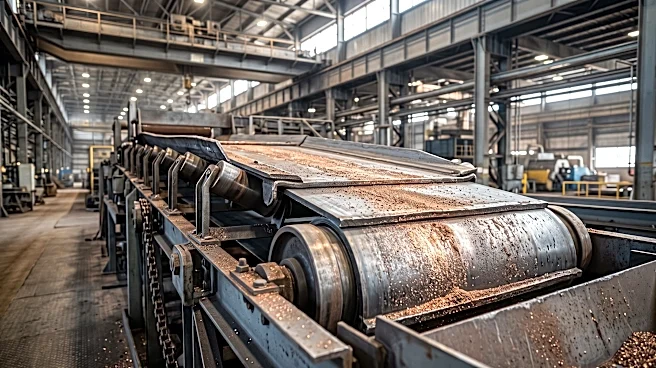
S.A. The company reported a significant increase in EBITDA to $84.36 million in FY2026, up from $21.37 million in FY2025. Revenue also saw a substantial rise, reaching $182.04 million compared to $98.90 million in the previous fiscal year. In Spain, Orovalle produced 37,775 gold ounces, exceeding the upper end of its guidance, and copper production was within its target range. In Bolivia, EMIPA commenced processing oxide ore through its expanded Don Mario metallurgical plant, producing 1,597 ounces of gold, 14,680 ounces of silver, and 411,274 pounds of copper in FY2026. The plant is currently ramping up towards its design capacity of approximately 1,700 tonnes per day, targeted by the end of December 2026. Additionally, EMIPA successfully repaid its Bonds I, which matured on November 7, 2026.
Why It's Important?
This announcement is important for investors and stakeholders in the mining sector, particularly those focused on gold, copper, and silver production. Orvana Minerals' strong financial performance in FY2026, marked by a substantial increase in EBITDA and revenue, indicates operational efficiency and successful execution of its strategies in Spain and Bolivia. The exceeding of gold production guidance in Spain highlights the effectiveness of Orovalle's operations. The successful ramp-up of the Don Mario metallurgical plant in Bolivia signifies progress in expanding production capabilities and diversifying revenue streams. The repayment of Bonds I by EMIPA demonstrates financial stability and prudent debt management, which can enhance investor confidence. The detailed FY2027 guidance provides transparency and allows investors to assess the company's future prospects and potential returns. The ongoing exploration activities in Argentina, particularly the evaluation of a deeper porphyry-style copper-gold system, could unlock significant long-term value and growth opportunities for the company, impacting its market valuation and strategic positioning in the global mining industry.
What's Next?
For fiscal year 2027, Orvana Minerals has provided specific guidance for its operations. Orovalle in Spain is projected to produce between 27,000 and 31,000 ounces of gold and 2.1 to 2.3 million pounds of copper. EMIPA in Bolivia is expected to produce 22,000 to 26,000 ounces of gold and 14.0 to 16.0 million pounds of copper. The Don Mario plant in Bolivia is targeted to reach its design capacity of approximately 1,700 tonnes per day by the end of December 2026. A meeting of Bonds II bondholders is scheduled for November 30, 2026, to address covenant situations, which could involve amendments, waivers, or an extension of the Cure Period. The company plans an extensive exploration program at its Taguas Project in Argentina, involving approximately 19,500 meters of drilling from December 2026 to May 2027, with a preliminary budget of $15 million. This program aims to further evaluate the existing oxide resource and the potential for a deeper porphyry-style copper-gold system.
Beyond the Headlines
The financial health and operational expansion of Orvana Minerals reflect broader trends in the global mining industry, where companies are increasingly focusing on optimizing existing assets and exploring new high-potential deposits to meet growing demand for critical minerals. The successful integration of new processing technologies, as seen with EMIPA's expanded metallurgical plant, underscores the industry's drive towards efficiency and higher recovery rates. The strategic exploration in Argentina for a porphyry-style copper-gold system highlights the long-term investment in discovering significant, large-scale mineral deposits, which are crucial for future supply chains. The company's ability to manage its financial covenants and debt obligations, particularly with the EMIPA Bonds II, will be a key indicator of its financial resilience in a volatile market. This also touches upon the ethical and environmental considerations inherent in mining, as exploration and production activities must navigate complex regulatory landscapes and community expectations, especially in regions like South America.