



What's Happening?
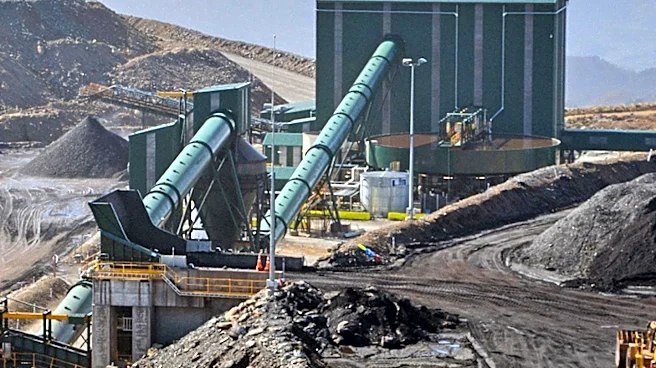
China has launched the world's largest iron ore magnetization roasting project in Anshan, Liaoning Province, which is capable of converting discarded mine tailings into high-grade iron concentrate. This facility, developed by the Institute of Process
Engineering (IPE) under the Chinese Academy of Sciences (CAS), has successfully passed official acceptance tests and is now operating at full capacity. The technology can process 6.13 million US tons (5.56 million tonnes) of refractory iron ore and tailings annually, transforming ultra-low-grade tailings with just 11 percent iron into concentrate with a 65 percent iron grade. This marks the first time such low-grade iron tailings have been processed at an industrial level globally, a breakthrough that took decades of research and development.
Why It's Important?
This innovation is highly significant for China and the global iron ore market. China is the world's largest consumer of iron ore, utilizing over half of the global supply, yet it relies on foreign suppliers for more than 80 percent of its needs. Despite holding the world's fourth-largest iron ore reserves, much of it is low-grade and difficult to process economically with conventional methods. This new plant directly addresses this challenge by enabling the efficient recovery of iron from previously unusable waste, potentially reducing China's heavy reliance on imports from countries like Australia, Brazil, India, and South Africa. Furthermore, the process is energy-efficient, consuming 35 percent less energy than existing technologies, which has positive environmental implications by reducing waste and energy consumption in the mining sector. This technological advancement could reshape global iron ore trade dynamics and enhance China's resource security.
What's Next?
The successful operation of this plant is expected to pave the way for broader adoption of this technology within China and potentially globally. The project is a key part of state-owned steelmaker Ansteel Group's larger plan to reprocess 24 million tonnes (26.46 million tons) of iron tailings annually, indicating a strategic commitment to this method. Future developments may include the construction of more such facilities across China, further reducing the nation's dependence on imported iron ore. Researchers will likely continue to refine the fluidized-bed magnetizing roasting method to optimize efficiency and expand its application to other types of low-grade ores. The environmental benefits, such as reduced waste and lower energy consumption, could also encourage other mining nations to explore similar technologies, leading to a more sustainable global mining industry.
Beyond the Headlines
This technological breakthrough has profound implications beyond immediate economic benefits. Environmentally, it represents a significant step towards circular economy principles in the mining industry, transforming waste into valuable resources and reducing the environmental footprint of iron production. The ability to utilize low-grade domestic reserves could also enhance national resource sovereignty and reduce geopolitical vulnerabilities associated with reliance on foreign supply chains. Socially, the creation of new industrial processes and facilities could lead to job creation and economic development in regions with abundant mine waste. However, it also raises questions about the long-term ecological impact of large-scale waste reprocessing and the potential for new forms of industrial pollution. The decades-long research effort underscores the importance of sustained investment in scientific and engineering innovation to address critical resource challenges.