


What's Happening?
A Lucid Motors employee, Shobhit K. Srivastava, has announced his departure from the electric vehicle company to join DoorDash's Robotics & Physical AI division. Srivastava, who described his time at Lucid as an 'incredible journey,' highlighted his involvement
in developing compelling vehicles and collaborating with talented teams focused on innovation. He expressed gratitude for the leadership and support received from individuals such as Derek Allen, Hasan Kahyaoglu, Lindsey Holland, Eric Bach, Charles Wildig, and Vivek Attaluri. His move signifies a shift from the automotive sector to the rapidly evolving field of robotics and artificial intelligence, particularly as it applies to the physical world. Srivastava is looking forward to contributing to the advancement of autonomy, robotics, and AI at DoorDash, aiming to translate ambitious technology into scalable, real-world impact.
Why It's Important?
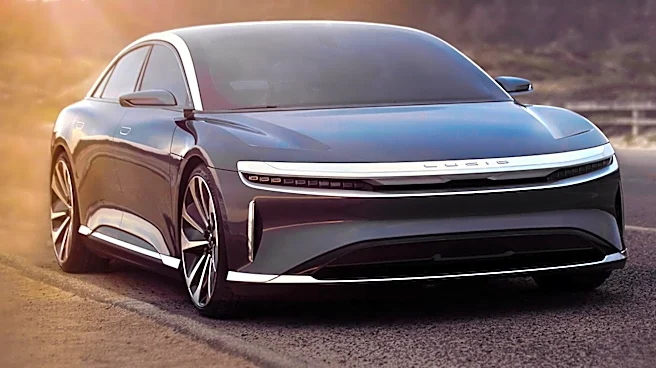
This personnel change is significant as it reflects the growing demand for talent in the robotics and AI sectors, particularly within companies like DoorDash that are exploring advanced automation for logistics and delivery. For Lucid Motors, the departure of an experienced employee could represent a loss of institutional knowledge or expertise, though the company continues to innovate in the electric vehicle space with models like the Lucid Air and Gravity. For DoorDash, bringing in talent with experience in complex engineering and innovation, as demonstrated by Srivastava's work at Lucid, could accelerate its efforts in developing and deploying robotic solutions. This move underscores a broader trend of skilled professionals transitioning between high-tech industries, driven by opportunities in emerging fields like AI and robotics, which are poised to reshape various sectors of the U.S. economy.
What's Next?
Srivastava's transition to DoorDash's Robotics & Physical AI division suggests an increased focus by DoorDash on integrating advanced autonomous systems into its operations. This could lead to the development of new delivery methods, potentially involving robotaxis or other automated vehicles, which could enhance efficiency and reduce operational costs for the company. For Lucid Motors, the company will likely continue its recruitment efforts to fill any gaps left by departing employees, maintaining its focus on electric vehicle development and software updates like Air UX 3.0. The broader implications point to a competitive landscape for talent in the tech industry, where companies are actively seeking individuals with expertise in cutting-edge technologies to drive future growth and innovation in areas such as logistics, transportation, and artificial intelligence.
Beyond the Headlines
This move highlights the increasing convergence of different technological sectors, where expertise gained in one area, such as electric vehicle development, can be highly valuable in another, like robotics and AI for logistics. The 'physical AI' aspect mentioned by Srivastava suggests a future where AI-driven systems will interact more directly with the physical world, moving beyond purely digital applications. This trend could lead to significant ethical and regulatory discussions regarding the deployment of autonomous systems in public spaces, particularly concerning job displacement, safety, and accountability. The shift also underscores the dynamic nature of career paths in the tech industry, where continuous learning and adaptability to new technological frontiers are crucial for professional growth and impact. The competition for such specialized talent will likely intensify, influencing recruitment strategies and compensation across various tech-driven industries.