







What's Happening?
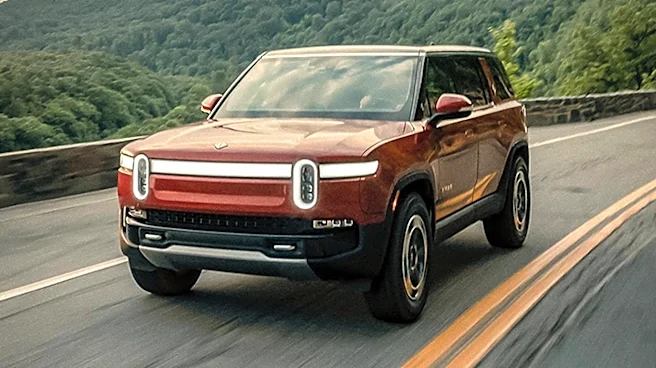
Rivian Automotive (RIVN) has issued a recall for 98,828 vehicles to address a software defect affecting the rearview camera. This recall is being managed through an over-the-air update, highlighting the company's reliance on technology for vehicle maintenance
and updates. The announcement has brought renewed attention to Rivian's operational and regulatory risks. Following this news, Rivian's stock has experienced a downturn, with a 7-day share price return down 3.71% and a year-to-date return down 23.80%. Despite this, some market narratives suggest the stock is undervalued, with a fair value pegged closer to $19.23 compared to its closing price of $14.79. The company's R2 platform is anticipated to significantly improve its cost structure by reducing the bill of materials by nearly 50% compared to the R1, which is expected to enhance gross margins and accelerate the path to profitability as production scales.
Why It's Important?
This recall is significant for Rivian Automotive as it underscores the challenges and risks associated with scaling electric vehicle production and integrating advanced software systems. While over-the-air updates offer a convenient solution for rectifying software issues, frequent recalls can erode consumer confidence and draw scrutiny from regulatory bodies. The stock's performance reflects investor concerns regarding execution risks and ongoing cash burn, despite optimistic valuations suggesting the company is undervalued. The successful implementation of the R2 platform is crucial for Rivian's long-term financial health, as it aims to drastically cut per-unit costs and improve profitability. However, the current valuation, with a price-to-sales (P/S) ratio of 3.6x, is considerably higher than the U.S. auto sector average of 0.6x, indicating that investors are paying a premium for anticipated growth that has yet to translate into profitability. This premium makes the stock particularly sensitive to operational setbacks and market sentiment shifts.
What's Next?
Rivian will proceed with the over-the-air software update to rectify the rearview camera defect in the affected vehicles. The market will closely monitor the company's ability to execute this recall smoothly and without further complications, as it will influence investor perception of its operational capabilities. The development and launch of the R2 platform will be a critical focus, with expectations for it to significantly improve cost efficiency and gross margins. Investors will be looking for concrete signs of progress towards profitability and reduced cash burn. Any delays or further operational issues with the R2 platform could challenge the current narrative of the stock being undervalued and potentially lead to further re-pricing by the market. Additionally, the company's ability to secure funding and manage its growth assumptions will be under continuous scrutiny.
Beyond the Headlines
The recall highlights a broader trend in the automotive industry, where vehicles are increasingly becoming software-defined products. While this allows for remote updates and fixes, it also introduces new vectors for defects and recalls, shifting the nature of automotive reliability from purely mechanical to a blend of hardware and software integrity. For Rivian, a company positioned as an innovator in the EV space, managing these software-related challenges effectively is paramount to maintaining its brand image and competitive edge. The high P/S ratio, significantly above industry averages, reflects a market betting on future potential rather than current performance. This speculative valuation means that any perceived missteps, such as recalls or delays in achieving cost efficiencies with new platforms like R2, can have an outsized impact on its stock price and investor confidence. The long-term success of Rivian, and similar EV startups, will depend not only on technological innovation but also on robust operational execution and effective risk management in a rapidly evolving market.