





What's Happening?
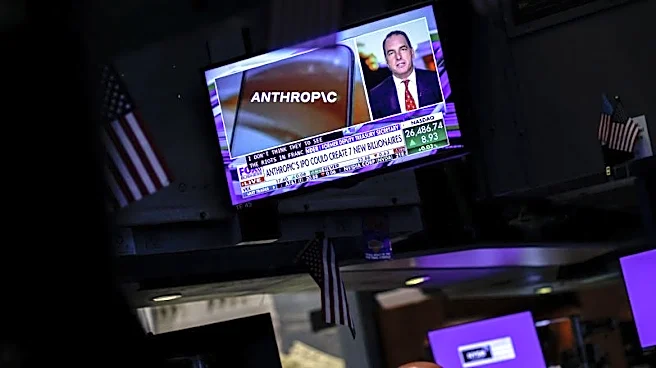
SoftBank Group experienced a substantial decline in its Tokyo-listed shares, falling 14.48% on November 20, marking its worst day since August 2024. This downturn occurred amidst a broader selloff in the artificial intelligence (AI) sector, following
the IPO of Anthropic, a rival to OpenAI, in which SoftBank is a major backer. Concurrently, Arm Holdings (ARM), a U.K.-based semiconductor intellectual-property company whose American depositary receipts trade on Nasdaq, saw its shares drop 14.09% to $152.20 in New York on the same day. SoftBank owns 86.4% of Arm and has pledged 72.0% of these shares, totaling 769.0 million shares, behind a $25 billion margin loan. As of September 30, SoftBank had drawn $25 billion on this Arm-backed loan, which translates to approximately $32.51 per pledged share, or about 21% of Arm's closing price of $152.20. SoftBank affiliates also accounted for 14.3% of Arm's fiscal 2026 revenue, with an unbilled balance of $617.3 million from these affiliates as of September 30.
Why It's Important?
The significant pledge of Arm Holdings shares by SoftBank behind a $25 billion margin loan introduces a notable risk factor for Arm investors and the broader semiconductor market. If SoftBank were to default on this loan, lenders could foreclose on the pledged shares, potentially flooding the market with a large volume of Arm stock. This influx could significantly depress Arm's share price, impacting its valuation and investor confidence. Furthermore, SoftBank's substantial role as a customer, contributing 14.3% of Arm's fiscal 2026 revenue, creates a dependency. Any reduction in work commissioned by SoftBank due to its own financial pressures, such as the reported ¥1.12 trillion ($7.1 billion) net loss for the September quarter and a $3.7 billion charge related to U.S. AI data centers, could directly affect Arm's future revenue streams. This interconnectedness means that SoftBank's financial health and strategic decisions have a direct bearing on Arm's performance and market stability, affecting U.S. investors holding Arm's American depositary receipts.
What's Next?
Investors will closely monitor Arm's fiscal third-quarter report in early February for updates on the unbilled balance from SoftBank affiliates. A more critical test will be whether Arm receives a fixed $300 million payment from SoftBank by March 31, 2027. The receipt of this payment would indicate SoftBank's continued ability to meet its financial obligations to Arm, irrespective of its own stock performance. The market will also be watching for any further developments in the AI sector, as a broader AI selloff could continue to impact SoftBank and, by extension, Arm. Analysts currently project Arm's revenue to grow from $4.92 billion in fiscal 2026 to $8.37 billion in fiscal 2028, but these projections could be revised based on SoftBank's future actions and the overall market sentiment towards AI investments. The potential for lenders to foreclose on pledged shares remains a long-term concern, which could significantly alter Arm's public float and market dynamics.
Beyond the Headlines
The situation highlights the intricate financial relationships and potential vulnerabilities within the global technology investment landscape, particularly concerning large holding companies and their portfolio assets. SoftBank's strategy of leveraging its stake in Arm through a substantial margin loan underscores a broader trend of using valuable assets to finance ambitious ventures, such as investments in AI. This approach, while potentially lucrative, also concentrates risk. The interconnectedness between SoftBank's financial health, its AI investments, and Arm's operational revenue raises questions about corporate governance and the transparency of such complex financial structures. The potential for a significant portion of a publicly traded company's shares to be subject to foreclosure due to a parent company's loan default introduces a unique layer of market instability, potentially affecting investor confidence in companies with similar ownership structures. This scenario could prompt greater scrutiny from regulators and investors regarding the pledging of significant equity stakes in publicly traded entities.