




What's Happening?
ANYbotics AG has introduced ANYbotics Shift, a new platform designed to simplify asset health assessments and enable preventive maintenance through autonomous robotic inspections. The company states that undetected failures cost the world's 500 largest
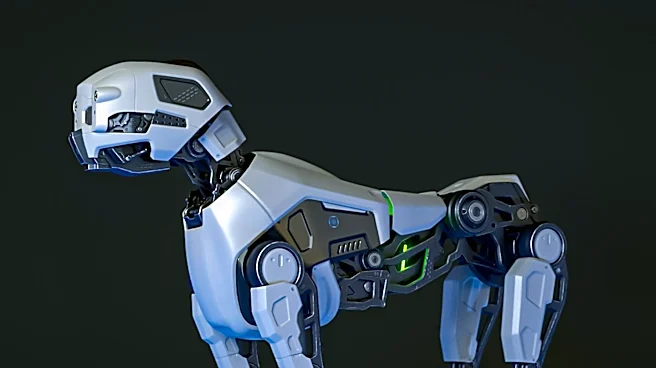
companies an estimated $1.4 trillion annually in downtime, with a single hour of outage averaging $250,000. Shift aims to address this by unifying plant mapping, robot fleet coordination, inspection AI analytics, and systems integrations into one platform. Its core AI functionality transforms field findings into work orders, preventing unplanned downtime. The platform is cloud-based and offers four interconnected modules: Shift Fleet for scheduling and monitoring robot fleets, Shift Insight for combining various sensor readings with operating conditions to identify anomalies, Shift Connect for integrating anomalies into existing operations software to create work orders, and Shift Maps for providing a live digital twin of a manufacturing plant. ANYbotics, founded in 2016, specializes in ANYmal quadruped robots for routine inspections and real-time data collection, serving industries such as energy, power, metals, mining, and chemicals.
Why It's Important?
The launch of ANYbotics Shift is significant for U.S. industries, particularly those with extensive infrastructure and complex operational environments like manufacturing, energy, and mining. By automating inspections and integrating data directly into maintenance workflows, the platform can drastically reduce costly downtime, which currently amounts to billions of dollars annually for large corporations. This technology addresses critical labor shortages in skilled inspection roles and enhances worker safety by deploying robots in hazardous environments. Companies stand to gain substantial financial benefits through improved operational efficiency, predictive maintenance capabilities, and the ability to identify potential failures before they escalate. The platform's ability to integrate with existing enterprise systems like SAP and GE Vernova APM means a smoother adoption process for businesses already invested in such infrastructure, making it a compelling solution for optimizing asset management and ensuring continuous operation.
What's Next?
ANYbotics Shift is immediately available globally, including in North America. The company plans to roll out full fleet management for non-ANYmal hardware next year, aiming for Shift to become a single operational hub for mixed-robot fleets. ANYbotics also intends to help shape a unified inspection-robot standard, as one currently does not exist in the U.S. or Europe. The platform will continue to evolve, with Shift AI learning from every connected module to enhance its capabilities. Customers can expect ongoing improvements in integration with enterprise systems, with minimal effort required for initial setup. The company will also expand its notification center to include SMS and WhatsApp support. Early adopters, such as the Sacramento Municipal Utility District (SMUD), have already reported significant savings and improved detection of critical issues, indicating a strong potential for broader adoption and impact across various industrial sectors.
Beyond the Headlines
The introduction of ANYbotics Shift represents a broader trend towards the industrial application of artificial intelligence and robotics, moving beyond mere automation to intelligent, predictive operational management. This shift has profound implications for the future of industrial labor, potentially redefining roles and requiring new skill sets for managing and interpreting robotic data. The emphasis on cybersecurity, with ISO 27001 standards and end-to-end encryption, highlights the growing importance of data integrity and security in an increasingly interconnected industrial landscape. Furthermore, the platform's ability to create a 'digital twin' of a manufacturing plant signifies a move towards more comprehensive and integrated digital transformation strategies, where physical assets are continuously monitored and optimized in a virtual environment. This could lead to more resilient supply chains, reduced environmental impact through optimized resource use, and a fundamental change in how industries approach maintenance and operational planning.