


What's Happening?
Keysight Technologies, Inc. has announced the release of two new 1.6T Ethernet test platforms: the Switch and Edge Router Tester (SERT) 1600GE and the AresONE Plus 1600GE. These platforms are designed to assist customers in validating next-generation
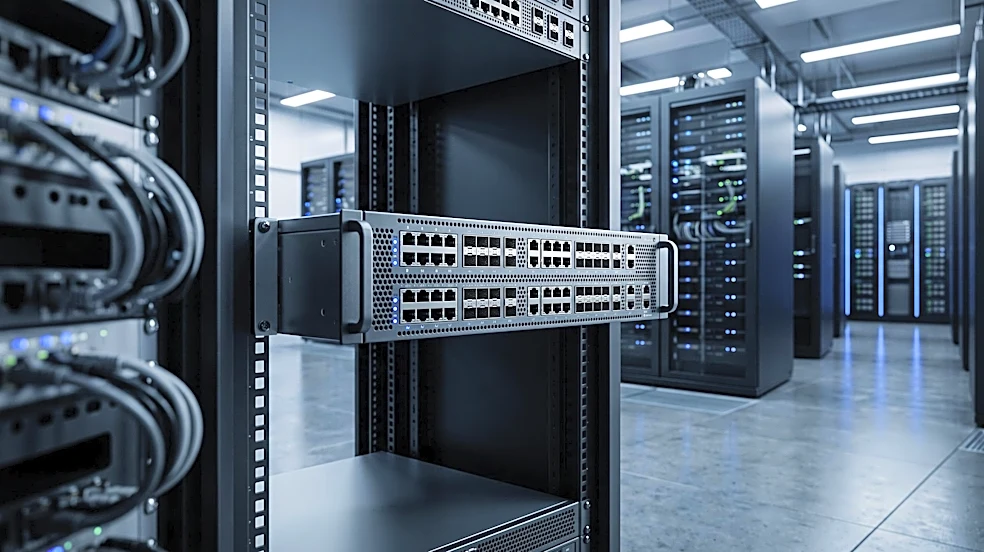
AI data center and hyperscale networking infrastructure. The AresONE Plus 1600GE is notable for delivering eight 1.6T Ethernet ports within a single 2U appliance, offering stateful and realistic AI workload generation through mix-of-experts emulation. The SERT 1600GE is tailored for data center switch fabric and edge router validation. Both platforms aim to provide a consistent testing foundation for device qualification, routing, and AI fabric validation, supporting performance, interoperability, and control-plane evaluation as networks expand. Key capabilities include support for 1600GE PAM4 signaling over 224G SerDes, backward compatibility to 112G, and flexible port breakout options. The platforms also support various protocols like Border Gateway Protocol (BGP), Equal-Cost Multipath (ECMP), and Virtual Extensible LAN (VXLAN).
Why It's Important?
The introduction of these 1.6T Ethernet test platforms by Keysight Technologies is crucial for the advancement of AI infrastructure and hyperscale data centers. As AI workloads become more complex and data-intensive, the demand for higher bandwidth and more reliable networking solutions escalates. These new testing tools enable companies to rigorously validate their network infrastructure, ensuring that it can handle the unprecedented demands of AI factories. By providing realistic AI workload emulation and high-density switching capabilities, Keysight helps prevent performance bottlenecks and congestion issues before deployment. This is vital for industries relying on large-scale AI, such as cloud computing, autonomous systems, and advanced analytics, where network efficiency directly impacts operational success and innovation. The collaboration with companies like NVIDIA further underscores the importance of these validation tools in building robust and scalable AI Ethernet fabrics.
What's Next?
The immediate next step for Keysight Technologies involves showcasing these new platforms at industry events like the Open Compute Project (OCP) Global Summit, where they can demonstrate their capabilities to potential customers and partners. As AI infrastructure continues to evolve, Keysight will likely focus on further enhancing these platforms to support even higher speeds and more complex AI workloads. The adoption of these testing solutions by data center operators and network equipment manufacturers is expected to accelerate the deployment of 1.6T Ethernet technology. This will lead to more efficient and powerful AI data centers, driving innovation across various sectors. Future developments may include integration with emerging networking standards and continued collaboration with leading AI hardware providers to ensure compatibility and optimal performance in next-generation AI environments.
Beyond the Headlines
The launch of Keysight's 1.6T Ethernet test platforms signifies a deeper shift in the technological landscape, highlighting the critical role of robust testing and validation in the era of artificial intelligence. Beyond simply enabling faster networks, these tools address the fundamental challenge of ensuring reliability and performance in highly synchronized, specialized AI clusters where every packet and nanosecond counts. This development underscores the increasing complexity of modern data centers, moving beyond fault-tolerant commodity scaling to systems that require precise engineering and validation. The ethical implication lies in ensuring that the underlying infrastructure for AI is not only powerful but also stable and secure, as AI systems become more integrated into critical societal functions. Legally, the performance and reliability validated by such platforms could become a benchmark for compliance in data-intensive industries, influencing future regulatory frameworks for AI infrastructure.