







What's Happening?
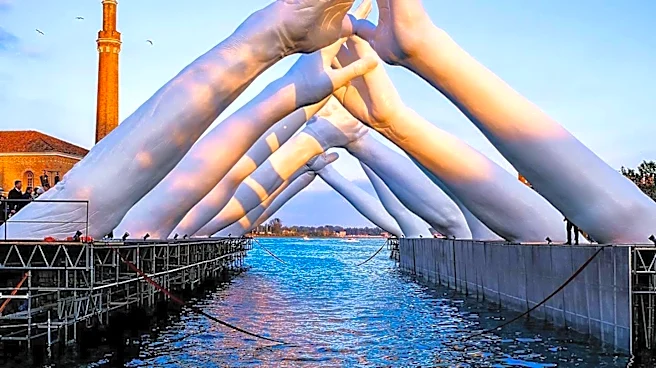
The Venice Biennial features art projects that delve into the tension between the human 'world' and the elemental 'earth,' exploring themes of opacity, unpredictability, and non-human temporalities. The Romanian Pavilion's 'Black Seas: Scores for the Sonic
Eye' constructs a multilayered vision of the Black Sea, intertwining elemental poetry, political commentary, and scientific observation. This includes installations like 'How to Mend a Broken Sea?' and 'Blue Ground,' which use 3D-printed artifacts and narratives from the perspective of a traveling diamond to invert extractive logic. Other pavilions, such as Lithuania's 'animism sings anarchy' and Poland's 'Liquid Tongues,' engage with ancient water rituals and alternative communication modes inspired by non-human life. These projects collectively emphasize a posthumanist perspective, moving beyond anthropocentric frameworks to highlight the agency of matter and the resistance of the elemental dimension to human measurement and control.
Why It's Important?
These art installations are important as they reflect a growing global discourse on environmentalism, decolonialism, and posthumanism, which are increasingly influencing cultural and intellectual spheres in the U.S. and worldwide. By challenging anthropocentric views and highlighting the 'untamed' aspects of nature, these projects encourage a re-evaluation of humanity's relationship with the environment. This shift in perspective can influence public policy discussions on climate change, resource management, and indigenous rights, promoting more holistic and sustainable approaches. For the art world, it signifies a move towards art as a form of knowledge and critical inquiry, rather than mere aesthetic pleasure, potentially shaping future artistic trends and academic studies in the U.S. and beyond.
What's Next?
The themes explored in these Biennial projects are likely to continue influencing contemporary art, academic research, and public discourse. We can expect to see more interdisciplinary collaborations between artists, scientists, and humanities scholars, fostering new forms of knowledge production and artistic expression. The emphasis on 'opacity' and the 'untamed' nature of the earth may lead to further artistic explorations that resist easy categorization or interpretation, pushing the boundaries of traditional art forms. Furthermore, these ideas could inspire educational initiatives and public engagement programs aimed at fostering a deeper understanding of ecological interconnectedness and challenging dominant narratives of human exceptionalism.
Beyond the Headlines
The deeper implication of these art projects lies in their challenge to the modern ideal of a wholly transparent and explicable world. By embracing the 'right to opacity' and the elemental dimension that resists human control, they invite a profound shift in how we perceive and interact with reality. This philosophical stance has ethical implications, urging a move away from exploitative relationships with nature towards a more respectful coexistence. Culturally, it can foster a greater appreciation for mystery, indeterminacy, and the non-human, potentially leading to a richer, more nuanced understanding of our place in the cosmos. This shift could also influence legal frameworks, pushing for recognition of the intrinsic rights of nature and a re-evaluation of property and ownership concepts.