



What's Happening?
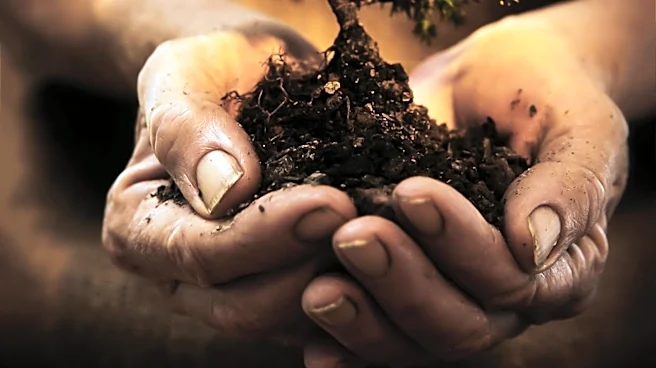
Legendary actress Kim Novak, known for her roles in films like 'Vertigo,' has revealed her wish to be transformed into compost after her death, with the aim of nurturing trees. At 93 years old, Novak views this as a way to achieve continuity and peace,
becoming part of nature. She hopes her friends will honor this desire by planting trees with her remains. Novak, who left Hollywood in 1966 to live closer to nature, now resides on a farm in Oregon, where painting and animals have become central to her life. She shared this sentiment with PETA, stating, 'Now I think that when I leave, it's okay, because I will become part of that beautiful tree and I will continue to grow.' Her career highlights include starring alongside Frank Sinatra in 'Picnic' and 'The Man with the Golden Arm' in 1955, and her iconic performance in Alfred Hitchcock's 1958 masterpiece, 'Vertigo.'
Why It's Important?
Kim Novak's unique post-mortem wish highlights a growing trend in end-of-life choices that prioritize environmental sustainability and a connection to nature. This personal decision by a public figure could bring increased awareness and acceptance to 'green burial' practices, such as human composting, which offer an eco-friendly alternative to traditional burial or cremation. For the funeral industry, this could signal a shift in consumer demand towards more sustainable options, potentially driving innovation and the development of new services. Her statement, particularly through an organization like PETA, also underscores a broader cultural movement towards environmental consciousness and a re-evaluation of humanity's relationship with the natural world, even in death. This could influence public discourse on death care, encouraging more individuals to consider their ecological footprint beyond their lifetime.
What's Next?
The public expression of Kim Novak's desire for human composting is likely to further discussions around alternative death care options. While her wish is personal, it contributes to a broader conversation about environmental responsibility and end-of-life planning. Advocacy groups for green burials and human composting may leverage her statement to raise awareness and push for wider legal acceptance and accessibility of these practices across the U.S. Currently, human composting is legal in several states, and increased public interest, potentially spurred by figures like Novak, could accelerate its legalization in others. This could lead to more funeral homes offering such services and a greater variety of eco-friendly memorial options becoming available to the general public. Her legacy, both as an actress and now as an advocate for natural decomposition, may inspire others to consider similar choices.
Beyond the Headlines
Kim Novak's choice to become compost transcends a simple end-of-life preference; it reflects a profound philosophical stance on existence, legacy, and our place within the natural cycle. By desiring to transform into a tree, she articulates a rejection of the finality of death, instead embracing it as a continuation of life in another form. This perspective challenges conventional Western views on death, which often emphasize preservation or dispersal, and aligns more closely with indigenous and ecological philosophies that see death as an integral part of the ecosystem. Her decision also subtly critiques the environmental impact of traditional burial and cremation, prompting a deeper ethical consideration of how our final acts affect the planet. It underscores a desire for authenticity and a return to fundamental values, echoing her earlier departure from Hollywood's artificiality to a life connected with nature.