








What's Happening?
The semiconductor industry is on the cusp of introducing Complementary Field Effect Transistors (CFETs), a new architecture poised to significantly enhance chip performance and density. Leading device manufacturers, including Intel, Samsung, TSMC, and IBM,
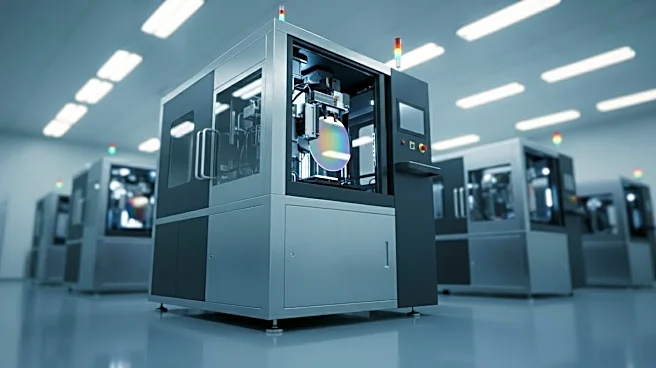
are developing CFETs, which involve stacking p-type and n-type transistors one on top of another. This innovation is projected to nearly double transistor density, improve packing density by 40%, deliver a 50% performance increase, and potentially achieve a 70% efficiency gain compared to current lateral nanosheets. While these companies are pursuing slightly different approaches to CFET construction, all are focused on optimizing materials and process flows for gate-stack fabrication and addressing the complex vertical connections required for signal and power lines. The transition to CFETs presents significant manufacturing challenges, including maintaining atomic-level control over critical dimensions and managing issues like warpage and defectivity at the nanometer scale.
Why It's Important?
The advent of CFET technology is a critical development for the U.S. technology and business sectors, promising a substantial leap in computing power and energy efficiency. This advancement will directly impact industries reliant on high-performance computing, such as artificial intelligence, data centers, and advanced mobile devices, by enabling more powerful and energy-efficient processors. U.S. companies like Intel are at the forefront of this innovation, which is crucial for maintaining competitive advantage in the global semiconductor market. The increased density and performance gains offered by CFETs will facilitate the development of next-generation electronics, driving economic growth and fostering innovation across various technological domains. Furthermore, the complex manufacturing processes involved will spur investment in advanced fabrication techniques and materials science, creating high-skilled jobs and strengthening the U.S. position in semiconductor research and development. The success of CFET implementation will determine the trajectory of technological progress for the next decade, influencing everything from consumer electronics to national security applications.
What's Next?
The rollout of CFETs is anticipated to begin in a few years, with production expected around 2031 at the A7 node. In the interim, semiconductor companies will continue to refine their specific CFET architectures and manufacturing processes. This includes extensive research into defect-free epitaxy, ALD dielectrics, and workfunction-optimized metals. Virtual simulation and multi-physics modeling will play an increasingly vital role in pathfinding, integration, and yield optimization, reducing the need for costly physical experimentation. Companies will also focus on addressing challenges related to backside power delivery, advanced wafer bonding, and highly accurate frontside-to-backside alignment processes. The maturation of high-NA EUV lithography will be crucial for simplifying complex patterning flows. The industry will also see continued efforts in design-technology co-optimization to mitigate potential performance reductions and ensure manufacturability at scale.
Beyond the Headlines
The transition to CFETs represents more than just an incremental improvement in chip technology; it signifies a fundamental shift in how transistors are designed and manufactured, pushing the boundaries of Moore's Law. This evolution raises profound questions about the limits of miniaturization and the increasing complexity of semiconductor fabrication. The reliance on atomic-level control and advanced simulation tools highlights the growing interdisciplinary nature of technological innovation, blending physics, materials science, and artificial intelligence. Ethical considerations may arise regarding the environmental impact of increasingly complex manufacturing processes and the energy consumption of ever-more powerful devices. Furthermore, the intense global competition among semiconductor giants to master CFET technology underscores its strategic importance, potentially leading to geopolitical implications as nations vie for dominance in advanced chip production. The long-term societal impact will be seen in the pervasive integration of AI and other advanced technologies into daily life, driven by the unprecedented processing capabilities enabled by CFETs.