







What's Happening?
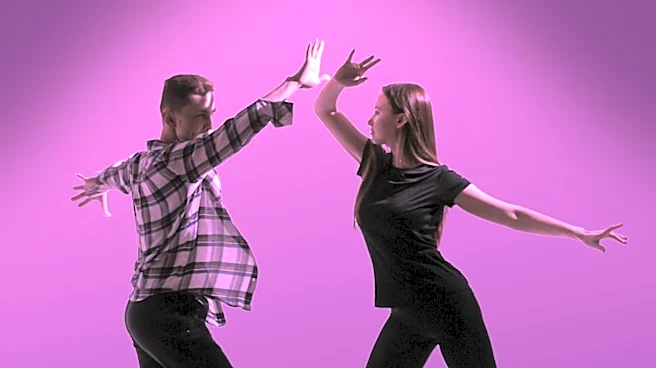
The Ellen Sinopoli Dance Company is engaging in a collaborative performance with the classical music ensemble Capital Duo, comprising pianist Duncan Cumming and violinist Hilary Cumming. This collaboration, scheduled for a Saturday evening performance at the UAlbany
Performing Arts Center, aims to explore how live music profoundly influences dancers' movements and emotional expression. Dancers like Liv Butowsky and Kyra Paulsen describe performing to live music as an 'infusion of life and breath,' requiring heightened presence and responsiveness due to unpredictable elements like pauses or tempo changes. The program includes a reprise of 'Boundary Behavior,' set to music by David Walther, and the debut of Sinopoli's 'Shadows,' set to music by Icelandic composer María Huld Markan Sigfúsdóttir. Neuroscience research indicates that live music elicits higher activity in the amygdala, a brain region crucial for emotional processing, compared to recorded music.
Why It's Important?
This collaboration highlights the unique and visceral connection between live music and dance, emphasizing how real-time artistic exchange can elevate performance. The dancers' experiences underscore that live music fosters a more authentic and raw physical response, making performances more compelling and emotionally resonant. In an era increasingly dominated by digital and artificial intelligence, this exploration reaffirms the irreplaceable value of live, human-to-human artistic interaction. The project also serves as an educational tool, as evidenced by Duncan Cumming's assignment for his UAlbany students to compare experiences of listening to scores versus witnessing them paired with live dance. This initiative enriches the cultural landscape by showcasing the dynamic interplay between different art forms and their profound impact on both performers and audiences.
Beyond the Headlines
The collaboration delves into the fundamental aspects of human experience, suggesting that the integration of live music and dance is an innate, primal form of relating. It challenges the modern tendency to separate these art forms, advocating for their inherent synergy. The heightened sensory experience described by the dancers—listening with their entire bodies—points to a deeper, non-verbal communication that transcends individual artistic disciplines. This project implicitly argues for the continued importance of live arts in fostering human connection and emotional depth in a technologically advanced world. It also offers insights into the psychological and physiological effects of live performance, demonstrating how artistic collaboration can unlock new dimensions of expression and understanding, making the 'energetically invisible become visible on the stage.'