

What's Happening?
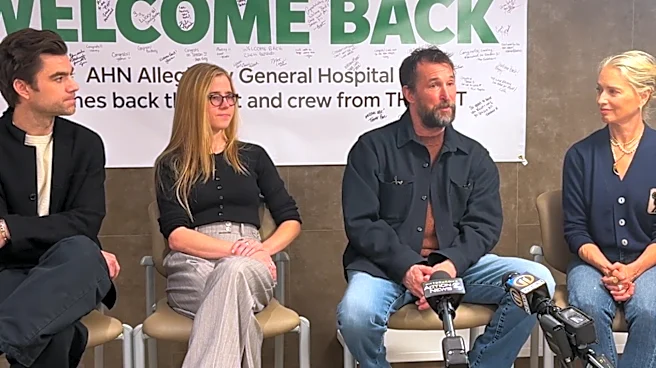
US actor Noah Wyle has recounted a childhood experience where comedian Eddie Murphy refused his autograph request with a harsh remark. Wyle, who was nine years old at the time, approached Murphy after watching him on 'Saturday Night Live' and asked for
an autograph. According to Wyle, Murphy initially questioned why he was awake so late before bluntly telling him to 'F— off.' This encounter left a lasting impression on Wyle, shaping his approach to interacting with young fans. As a result, Wyle stated on Amy Poehler’s 'Good Hang' podcast that he now always signs autographs for children, doing so quickly and willingly. The story has also become a playful family anecdote, with Wyle's 10-year-old daughter creating a mock autograph from 'Eddy' Murphy as a birthday gift, which Wyle has framed in his office.
Why It's Important?
This anecdote from Noah Wyle offers insight into the personal experiences that can shape public figures' interactions with their fans, particularly young ones. For Wyle, a negative encounter in his youth transformed into a positive commitment to his own fan base, demonstrating how celebrity behavior can have a ripple effect. It highlights the power dynamics inherent in fan-celebrity interactions and the lasting impact a brief moment can have on an individual. The story also touches on the broader theme of celebrity accessibility and the varying ways public figures choose to engage with their admirers. For young fans, a positive interaction can be a memorable and inspiring experience, while a negative one can be deeply disappointing. Wyle's decision to always sign autographs for children reflects a conscious effort to create positive memories for his young audience, contrasting with his own childhood experience.
What's Next?
While this story is a personal recollection rather than a developing news event, its retelling by Noah Wyle could subtly influence how other public figures consider their interactions with fans, especially children. It serves as a reminder within the entertainment industry about the impact of celebrity behavior. For Wyle, this principle is already ingrained in his professional conduct, ensuring that young fans who approach him will likely have a positive experience. The anecdote may also spark broader conversations among fans and media about the responsibilities and pressures faced by celebrities in public spaces. There are no direct 'next steps' in terms of policy or industry change, but the story contributes to the ongoing dialogue about celebrity culture and fan engagement.
Beyond the Headlines
Beyond the immediate narrative, Wyle's story delves into the psychological impact of celebrity encounters and the formation of personal ethics in public life. It illustrates how formative experiences, even seemingly minor ones, can shape an individual's professional conduct and personal philosophy. The anecdote also subtly critiques the often-unseen pressures on celebrities, who are constantly in the public eye and may react differently to fan interactions based on their own circumstances. However, Wyle's response—to actively counter his negative experience with positive actions—speaks to a broader theme of empathy and the desire to create a better experience for others. The story also highlights the generational aspect of celebrity, with Murphy being a prominent figure in Wyle's youth, and Wyle now being a figure for a new generation of fans, including his own daughter.