




What's Happening?
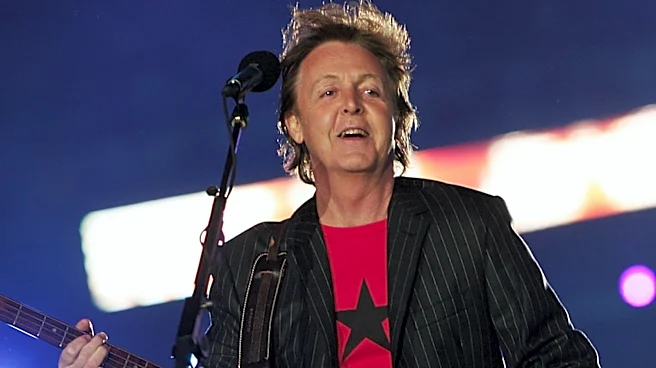
Paul McCartney's 1972 single 'Hi, Hi, Hi' was banned by the BBC due to its perceived sexually suggestive lyrics and drug references. Despite this controversy, McCartney himself considers it one of Wings' best singles. The song was created during Wings' early
touring period in Europe, with McCartney intending it as a high-energy track to conclude live shows. Its strong live reception prompted its release as a single, paired with 'C Moon' as a double A-side. The ban marked the second time in 1972 that a Wings song faced such action from the BBC, following 'Give Ireland Back to the Irish' which was banned for its political content. McCartney expressed surprise at the interpretation of 'Hi, Hi, Hi' but acknowledged its provocative aspects. The single still achieved commercial success, reaching number 5 on the UK charts and remaining there for 13 weeks.
Why It's Important?
The BBC's ban on 'Hi, Hi, Hi' highlights the cultural sensitivities and censorship prevalent in media during the early 1970s, particularly concerning rock music. This incident underscores the tension between artistic expression and societal norms, demonstrating how interpretations of lyrics could lead to significant broadcast restrictions. For Paul McCartney and Wings, the ban, coming shortly after another politically charged song was censored, likely reinforced their image as artists willing to push boundaries. Despite the ban, the song's commercial success indicates that public reception often diverged from official censorship, showcasing the power of popular music to circumvent traditional gatekeepers. This event also contributed to the narrative of Wings establishing its own identity, separate from The Beatles, by creating music that was both commercially viable and, at times, controversial.
What's Next?
The historical context of 'Hi, Hi, Hi' continues to be a point of discussion in music retrospectives and analyses of censorship in music. Future discussions about Paul McCartney's post-Beatles career will likely reference this period, emphasizing his efforts to forge a new musical path with Wings. The song's enduring presence on 'Wings Greatest' album, alongside more commercially successful tracks, ensures its continued recognition. This incident serves as a case study for understanding the evolving relationship between artists, media, and public morality. It may also influence how contemporary artists approach lyrical content, considering potential interpretations and reactions from broadcasters and audiences. The legacy of 'Hi, Hi, Hi' remains a testament to McCartney's diverse songwriting abilities and his willingness to experiment with different musical styles and themes.
Beyond the Headlines
The controversy surrounding 'Hi, Hi, Hi' delves into deeper questions about artistic intent versus public perception and the role of media in shaping cultural discourse. While McCartney may have intended the song as a simple, energetic rock track, its reception by the BBC reveals how language and imagery can be interpreted in unforeseen ways, especially when associated with rock and roll's rebellious image. This incident also touches upon the broader theme of moral panics surrounding popular culture, where certain artistic expressions are deemed threatening to public decency. The fact that the ban did not prevent the song from becoming a hit suggests a growing public appetite for music that challenged conventional norms, ultimately contributing to a more liberal cultural landscape. It highlights the often-subjective nature of censorship and the resilience of artistic works in the face of institutional disapproval.