
What's Happening?
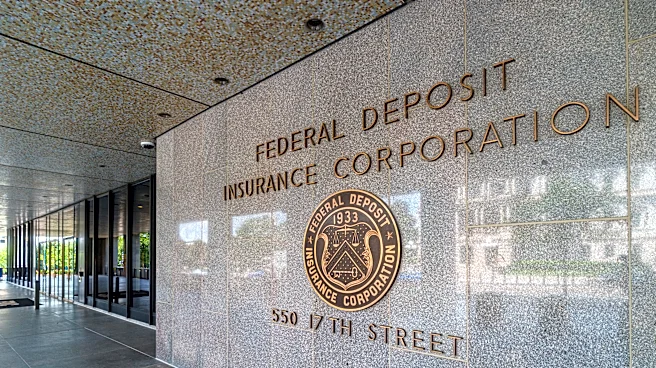
Following the failure of United Fidelity Bank, several regional banks are being highlighted as potential consolidators of distressed assets. The Federal Deposit Insurance Corporation (FDIC) recently closed
United Fidelity, marking the largest U.S. bank failure in over two years. This event has brought increased attention to regional banks with the capacity to absorb smaller, struggling institutions. Old National Bancorp, a Midwestern and Sunbelt-focused regional bank with $2.7 billion in revenue, is identified as a credible consolidator due to its traditional branch network and commercial focus. Similarly, Renasant, a Southeastern regional bank generating $1.1 billion in revenue, is also positioned to link directly to the consolidation of smaller community institutions. These banks offer consumer, commercial, and wealth management services, making them suitable candidates to integrate failed bank assets and operations.
Why It's Important?
The failure of United Fidelity Bank and the subsequent spotlight on regional bank consolidation underscore a significant trend in the U.S. financial sector. This environment presents both opportunities and risks. For stronger regional banks like Old National Bancorp and Renasant, the ability to acquire distressed assets can lead to accelerated earnings power and expanded market presence. These acquisitions can provide access to new customer bases, deposits, and loan portfolios, strengthening their competitive position. However, the process also introduces fresh risks, including the integration challenges of merging operations and managing potential liabilities from acquired institutions. The broader implication is a potential reshaping of the regional banking landscape, with stronger players growing through strategic acquisitions, while smaller, less resilient banks face increased pressure, especially amid unresolved funding costs and credit spread pressures.
What's Next?
The consolidation trend in the U.S. regional banking sector is expected to continue, with more banks likely to explore acquisition opportunities as market conditions evolve. The FDIC's role in managing bank failures and facilitating acquisitions will remain central. For banks like Old National Bancorp and Renasant, the focus will be on leveraging their existing infrastructure and financial health to strategically acquire and integrate failed banks. Analysts will closely monitor how these consolidators manage funding costs and credit spreads, which are critical factors influencing future profitability. The success of these acquisitions will determine their ability to generate further revenue contributions from commercial and industrial (C&I) and commercial real estate (CRE) lending, ultimately shaping their growth trajectories and the overall stability of the regional banking system.
Beyond the Headlines
Beyond the immediate financial implications, the ongoing consolidation in the regional banking sector could lead to a more concentrated banking industry. While this might result in greater stability for the overall financial system by eliminating weaker institutions, it could also reduce competition and potentially impact access to banking services for certain communities or small businesses. The ethical dimension involves ensuring that these consolidations do not lead to a reduction in localized banking support or an increase in fees for consumers. From a regulatory perspective, the FDIC and other oversight bodies will need to balance facilitating orderly transitions with maintaining a competitive and accessible banking environment. The long-term shift could see a more robust, albeit potentially less diverse, regional banking landscape in the U.S.