





What's Happening?
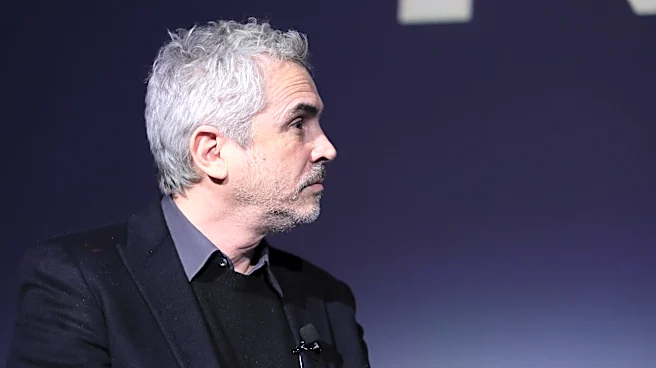
Alfonso Cuarón, an acclaimed director, is featured in a discussion regarding the portrayal of silence in cinema, specifically through his film 'Roma'. The Aposto Magazine article highlights three female characters from film history who experience silence,
with Cleo from Cuarón’s 'Roma' being one of them. The analysis delves into what a person's silence conveys, whether it signifies a lack of words, a suppression of speech, or a rejection of imposed language. Cleo's silence in 'Roma' is presented as a reflection of colonial history, class domination, and patriarchal structures. The article contrasts her silence with that of Ada in Jane Campion’s 'The Piano' and Elisabeth Vogler in Ingmar Bergman’s 'Persona', noting that while all three women fall silent, the underlying social, psychological, and political reasons differ significantly. The core theme revolves around whose voices are valued and heard in society, as depicted through these cinematic narratives.
Why It's Important?
The discussion surrounding Alfonso Cuarón's 'Roma' and its depiction of silence is important for understanding how film can critically examine societal power dynamics. By analyzing Cleo's silence, the article brings to light the enduring impacts of colonial history, class disparities, and patriarchal systems on marginalized individuals. This cinematic exploration encourages audiences to consider the broader implications of who is afforded a voice and whose experiences are silenced within various social contexts. For filmmakers and critics, it underscores the power of narrative to convey complex social commentaries without explicit dialogue. The film's approach to silence serves as a powerful tool for social critique, prompting viewers to reflect on real-world inequalities and the subtle ways in which certain groups are disempowered. This analysis contributes to a deeper appreciation of 'Roma' as more than just a personal story, but as a significant cultural commentary.
What's Next?
The ongoing critical analysis of films like 'Roma' is likely to continue influencing cinematic discourse and academic studies on representation and narrative techniques. Future discussions may further explore how contemporary filmmakers utilize silence as a narrative device to address social and political themes. This could lead to more scholarly works examining the intersection of film, history, and sociology, particularly concerning marginalized voices. The recognition of Cuarón's work in this context may also encourage other directors to experiment with non-verbal storytelling to convey profound messages. Furthermore, film festivals and educational institutions might feature 'Roma' in retrospectives or courses focusing on films that challenge traditional narrative structures and highlight social injustices through subtle yet powerful means. This ongoing engagement will solidify 'Roma's' place as a significant work in cinematic history.
Beyond the Headlines
Beyond its immediate narrative, 'Roma's' exploration of silence, as highlighted in the article, delves into profound ethical and cultural dimensions. Cleo's silence can be seen as a metaphor for the historical voicelessness of domestic workers and indigenous populations, particularly in post-colonial societies. This raises ethical questions about representation and the responsibility of storytellers to portray such experiences authentically. Culturally, the film challenges dominant narratives by centering the perspective of a character often relegated to the background, thereby shifting the audience's empathy and understanding. The long-term implication is a potential shift in how audiences perceive and value the stories of those traditionally marginalized, fostering a more inclusive cinematic landscape. It also encourages a deeper examination of how power structures are reinforced or challenged through the act of speaking or remaining silent, both on-screen and in real life.