




What's Happening?
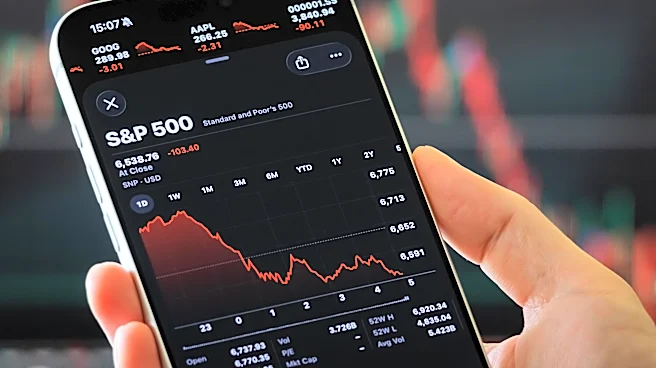
Goldman Sachs strategists have pinpointed three key developments that could signal the end of the current market downturn. The S&P 500 closed at 6,918.45 on November 20, 2026, marking seven consecutive sessions of losses and a 12% drop from its October
6 record. Technology stocks have been particularly affected, with the CBOE Volatility Index reaching its highest level in 19 months at 35.89 on November 20. The three catalysts identified by Goldman Sachs are renewed confidence in artificial intelligence (AI) earnings, a supportive Federal Reserve outlook, and a further decline in investor positioning. Each of these conditions addresses a different source of the current selling pressure, suggesting that an improvement in any one could help stabilize the broader market. David Kelly, Chief Global Strategist at J.P. Morgan Asset Management, noted that the correction reflects a return to pre-election concerns regarding AI profitability.
Why It's Important?
This analysis from Goldman Sachs is crucial for investors and the broader U.S. economy as it provides a framework for understanding potential market recovery. The S&P 500's decline and the heightened volatility indicate significant investor anxiety, which can impact investment decisions and economic stability. A sustained market downturn can affect retirement accounts, corporate valuations, and consumer confidence. The focus on AI earnings highlights the sector's outsized influence on recent market performance; a lack of confidence here could stifle innovation and investment in a critical growth area. A supportive Federal Reserve outlook, implying lower borrowing costs, is vital for businesses and consumers, influencing everything from corporate expansion to mortgage rates. Lastly, a reduction in investor positioning suggests that professional investors have largely exited their riskiest bets, potentially reducing future selling pressure and creating a more stable environment for new investment.
What's Next?
For the market to stabilize, according to Goldman Sachs, hyperscalers in the AI sector would need to demonstrate revenue growth that justifies their significant data center investments. This would restore confidence in AI earnings, a critical component given the sector's recent sell-off, which saw Goldman's basket of AI-related stocks fall 32% since October 6. Concurrently, a more supportive stance from the Federal Reserve, potentially through policies that lower borrowing costs, would be necessary. This could involve adjustments to interest rates or other monetary policy tools. Finally, a continued decline in investor positioning, meaning professional investors have largely divested from their largest bets, would indicate that fewer forced sellers remain, paving the way for a potential market rebound. Monitoring these three indicators will be key for investors looking for signs of a market bottom.
Beyond the Headlines
The current market correction, as analyzed by Goldman Sachs, extends beyond mere financial metrics, touching upon the fundamental valuation of emerging technologies and the psychological aspects of investor behavior. The emphasis on AI earnings underscores a broader societal and economic shift towards technology-driven growth, where the profitability of these innovations is under intense scrutiny. The Federal Reserve's role highlights the ongoing tension between controlling inflation and supporting economic growth, with its decisions having far-reaching implications for capital allocation and risk-taking across all sectors. The concept of 'investor positioning' also reveals the herd mentality and risk aversion that can dominate financial markets, where collective sentiment can amplify both gains and losses. This period of uncertainty could lead to a re-evaluation of investment strategies, potentially favoring more sustainable growth models over speculative ventures, and influencing regulatory approaches to emerging technologies.