




What's Happening?
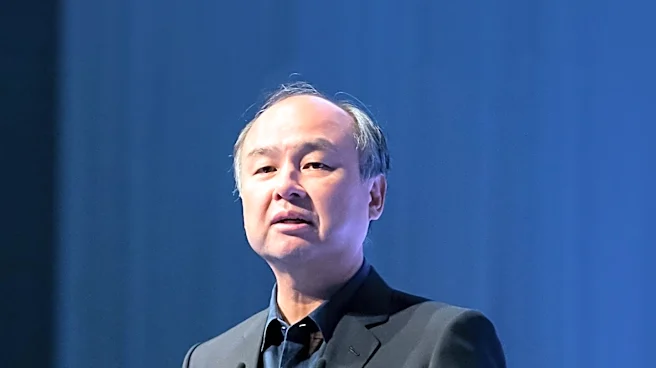
Masayoshi Son, founder and chief of SoftBank Group, has publicly acknowledged missing an investment opportunity in AI rival Anthropic, stating it was 'one of my mistakes.' This admission came on November 18, a day before Anthropic's market debut. SoftBank has heavily
concentrated its AI investments in OpenAI, committing $64.6 billion for approximately a 13% stake. Son explained that the decision to invest in OpenAI had already been made, and the company did not want to pursue two ventures simultaneously. Despite this, Son remains highly optimistic about the future of AI, dismissing concerns of an AI bubble and asserting that artificial intelligence is still in its nascent stages. His comments were made in Tokyo at a Nikkei business newspaper event. Two days after his remarks, SoftBank's stock experienced a significant decline, losing over 14% in a single trading day.
Why It's Important?
SoftBank's concentrated bet on OpenAI, to the tune of $64.6 billion, highlights a high-stakes strategy in the rapidly evolving AI sector. This approach carries substantial risk, as evidenced by the recent 14% drop in SoftBank's stock following Son's comments and investor concerns. The decision to forgo an investment in Anthropic, a direct competitor to OpenAI, underscores the competitive nature of the AI market and the potential for missed opportunities even for major players. The financial markets are closely scrutinizing SoftBank's strategy, particularly given the company's reported net loss of 1.12 trillion yen (approximately $7 billion) for the second business quarter. This financial performance, coupled with the significant investment in a single, non-publicly traded entity like OpenAI, raises questions about the long-term profitability and stability of SoftBank's AI-centric portfolio. The market's reaction suggests that investors are wary of the high dependency on OpenAI and the substantial capital required for data centers and other related infrastructure.
What's Next?
The future performance of SoftBank's stock and its overall financial health will largely depend on the development and monetization of OpenAI's technologies. Investors will be closely watching for signs of profitability from OpenAI and how SoftBank manages its substantial investment. The company's commitment to large-scale projects, such as a 20-year lease for eight gigawatts of computing capacity for OpenAI in Ohio, indicates a long-term vision that requires significant capital and sustained success. SoftBank's strategy to be involved in all stages of the AI chain—models, chips, data centers, and robotics—suggests continued aggressive investment in the sector. However, the recent stock decline and quarterly losses indicate that SoftBank faces pressure to demonstrate tangible returns on its AI bets. The market will also be observing any further shifts in the competitive landscape of AI, particularly as companies like Anthropic continue to grow and attract investment.
Beyond the Headlines
Masayoshi Son's unwavering belief in AI, despite market skepticism and significant financial losses, reflects a broader philosophical stance on technological disruption. His dismissal of an 'AI bubble' echoes past periods of rapid technological advancement where initial skepticism eventually gave way to widespread adoption and economic transformation. However, the substantial financial commitment to a single entity like OpenAI also raises questions about diversification and risk management in an inherently volatile sector. The ethical and societal implications of such concentrated power in AI development, particularly concerning data privacy, algorithmic bias, and the future of work, are also significant. SoftBank's strategy, while potentially revolutionary, could also exacerbate existing concerns about market concentration and the potential for a few dominant players to shape the future of artificial intelligence. The long-term success or failure of this strategy could serve as a case study for future large-scale technology investments.