





What's Happening?
Thales Alenia Space, a joint venture between Thales (67%) and Leonardo (33%), has signed a Letter of Agreement with Eutelsat. This agreement outlines Thales Alenia Space's role in providing governmental payloads for 330 IRIS2 telecommunications satellites,
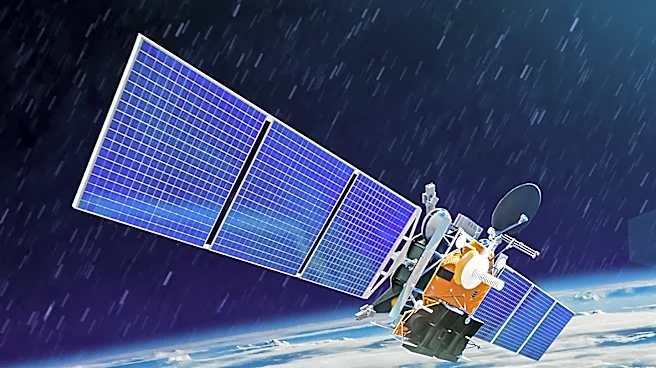
which will operate in Low Earth Orbit. The IRIS2 constellation is designed to be a new standard-bearer for Europe's autonomous and sovereign space capability, comprising a total of 348 satellites, with 330 in Low Earth Orbit and 18 in Medium Earth Orbit. The Low Earth Orbit satellites include 66 Ka-only satellites and 264 dual Ku/Ka satellites. These satellites will communicate via optical inter-satellite links and utilize a multi-orbit approach. The first 66 Ka-only satellites (IRIS2 Layer One) are scheduled for launch in 2029, with Thales Alenia Space developing the payloads and Airbus Defense and Space providing the platforms. IRIS2 Layer Two, consisting of 264 Ku/Ka satellites, will see Thales Alenia Space responsible for governmental payloads and Aerospacelab developing the platforms, with launches starting in 2030. This initiative is part of a larger IRIS2 contract for Thales Alenia Space, which is expected to exceed 3 billion euros overall.
Why It's Important?
This development is crucial for enhancing secure governmental communication services, civil protection, emergency management, and defense communications. The IRIS2 constellation will also provide commercial B2B services and serve as a backbone for other space-based Earth-observation and navigation infrastructures in Europe, acting as a data transmission relay. The system's dual-use nature, featuring groundbreaking technology, offers total control over data and an unprecedented level of security to address contemporary cybersecurity challenges. With native 5G capability, IRIS2 will employ payloads with active antennas to ensure precise pointing and maximum signal power over specific regions. The project aims to enable the first secure space-based 5G network, incorporating in-orbit traffic routing, active interference management, and end-to-end secure communications. The development of a dedicated chipset for software-defined antennas will further enhance system capacity, flexibility, and mission agility, strengthening Europe's sovereignty and space autonomy.
What's Next?
The first phase of the IRIS2 project, involving the launch of 66 Ka-only telecommunications satellites (IRIS2 Layer One), is scheduled for 2029. Following this, IRIS2 Layer Two, comprising 264 Ku/Ka telecommunications satellites, is slated for launch starting in 2030. Thales Alenia Space will continue to develop the governmental payloads for these satellites, while Airbus Defense and Space and Aerospacelab will provide the platforms for Layer One and Layer Two, respectively. The ongoing development will focus on integrating advanced technologies such as in-orbit traffic routing, active interference management, and end-to-end secure communications to establish a robust and secure space-based 5G network. The company also plans to develop a dedicated chipset for software-defined antennas to further optimize the system's performance and adaptability.
Beyond the Headlines
The IRIS2 constellation represents a significant step towards greater digital sovereignty and resilience for Europe. By establishing an autonomous and secure space-based communication infrastructure, Europe aims to reduce reliance on external systems for critical governmental and commercial communications. This initiative also highlights the increasing convergence of space technology with terrestrial communication networks, particularly with the integration of 5G capabilities. The emphasis on cybersecurity and data control within the IRIS2 system reflects a growing global concern over data privacy and national security in the digital age. Furthermore, the project's dual-use nature, serving both governmental and commercial needs, could set a precedent for future large-scale satellite constellations, fostering innovation in satellite design, payload technology, and secure communication protocols. The long-term implications include enhanced capabilities for disaster response, defense operations, and the expansion of high-speed internet access in underserved areas.