




What's Happening?
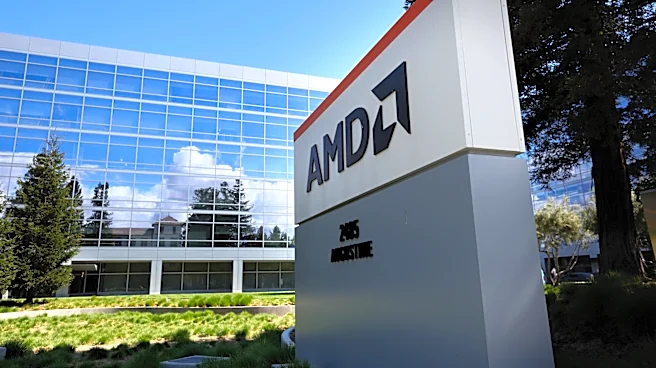
OpenAI co-founder and President Greg Brockman recently announced that OpenAI's models have achieved approximately an additional year of progress on AMD's chip development in under five months. This accelerated development has resulted in a 'taped-out'
design, meaning the chip design is finalized and ready for manufacturing. AMD CEO Lisa Su expressed pride in these results. This collaboration is particularly significant as OpenAI plans to deploy up to 6 gigawatts of AMD GPUs and holds a warrant for up to 160 million AMD shares, which vests with a full 6-gigawatt deployment and a $600 share price. The rapid progress in chip design directly benefits OpenAI by providing better chips for its data centers and increasing the potential payoff from its AMD warrant.
Why It's Important?
This development is crucial for the competitive landscape of the AI chip market, potentially narrowing the lead currently held by Nvidia. OpenAI's direct involvement in enhancing AMD's chip roadmap underscores the growing trend of major AI developers influencing hardware design to optimize performance for their models. The financial implications are substantial for both companies; a faster AMD roadmap could lead to increased revenue for AMD, with analysts projecting its revenue to nearly triple from $34.6 billion in 2025 to $95.9 billion in 2027. For OpenAI, better and faster chips mean more efficient data centers and a potentially larger return on its investment in AMD shares, aligning the interests of both the designer and the buyer in accelerating technological advancements.
What's Next?
The immediate next step involves the manufacturing of the 'taped-out' AMD chip design. The success of this accelerated development could influence future collaborations between AI companies and chip manufacturers, potentially leading to more integrated design processes. Analysts will closely monitor AMD's revenue projections, particularly the shipment of its Helios rack systems to OpenAI and other major labs, as these are critical for AMD to meet its ambitious 2027 revenue targets. The market will also watch how Nvidia responds to this accelerated competition and whether OpenAI's strategy of developing custom accelerators with Broadcom will further diversify the AI chip ecosystem.
Beyond the Headlines
This collaboration highlights a deeper strategic shift in the technology industry where major AI developers are not just consumers of hardware but active participants in its design and optimization. This blurs the lines between software and hardware development, potentially leading to more specialized and efficient AI accelerators tailored to specific model architectures. The financial incentives, such as OpenAI's warrant in AMD, create a powerful feedback loop, encouraging continuous innovation and rapid iteration in chip design. This model could set a precedent for how AI advancements drive hardware evolution, fostering a more symbiotic relationship between AI research and semiconductor manufacturing, and potentially accelerating the overall pace of AI development globally.