





What's Happening?
Lightmatter, a Mountain View, California-based company specializing in photonic computing, has successfully raised $400 million in its Series D funding round. This latest investment brings the company's valuation to $4.4 billion. Lightmatter, founded
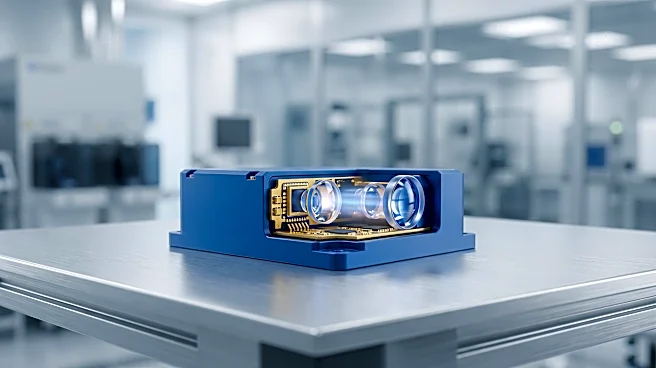
in 2017, operates in the computer hardware manufacturing industry, focusing on advanced AI infrastructure hardware, optical interconnect technology, and semiconductor packaging. Their product portfolio includes Photonic Interconnect Chips, Co-Packaged Optics (CPO) Solutions, VLSP Light Engines, 3D Photonic Interposers, and Reference Systems designed for AI Infrastructure. The company has now accumulated a total of $822 million across nine funding rounds. Lightmatter is actively expanding its operations, including hiring for roles such as Senior Staff Technical Program Manager to coordinate engineering efforts for its AI and Chiplet Interconnect products, spanning silicon development, packaging, assembly, and testing phases.
Why It's Important?
This significant funding round for Lightmatter underscores the growing investor confidence and strategic importance of photonic computing in the U.S. technology landscape. Photonic computing, which utilizes light instead of electrons for data processing, offers the potential for dramatically faster and more energy-efficient AI and high-performance computing (HPC) workloads. This advancement is crucial for addressing the escalating demands of AI data centers, which currently consume substantial amounts of energy and require increasingly powerful processing capabilities. Lightmatter's success could accelerate the development and adoption of these next-generation computing solutions, potentially giving the U.S. a competitive edge in AI infrastructure. Companies and industries heavily reliant on AI, such as cloud computing providers, research institutions, and defense, stand to gain from the enhanced performance and reduced operational costs that photonic computing promises. Conversely, traditional semiconductor manufacturers may face increased competition as photonic solutions mature.
What's Next?
Lightmatter plans to utilize the $400 million Series D funding to accelerate the development of data center photonics and expand all departments within the company. This expansion will likely involve significant investment in research and development to further refine their photonic engine, Passage™, and other related technologies. The company is actively recruiting, indicating a push to scale its engineering and operational capabilities. As Lightmatter continues to develop and deploy its photonic solutions, the industry can anticipate more efficient and powerful AI and HPC infrastructure. This could lead to new benchmarks in AI model training and inference, potentially enabling breakthroughs in various fields. The increased valuation also positions Lightmatter as a key player in the future of computing, potentially influencing industry standards and partnerships in the coming years.
Beyond the Headlines
The substantial investment in Lightmatter highlights a broader shift in the computing paradigm, moving beyond traditional electronic processors to explore alternative technologies like photonics. This transition is driven by the fundamental physical limitations of silicon-based electronics, particularly concerning heat generation and energy consumption at extreme scales. Photonic computing offers a path to overcome these barriers, potentially leading to a more sustainable and powerful digital infrastructure. The ethical implications of such advanced AI capabilities, powered by highly efficient photonic systems, will become increasingly relevant, particularly concerning data privacy, algorithmic bias, and the responsible deployment of AI. Furthermore, the development of these cutting-edge technologies could foster a new wave of innovation in materials science and quantum physics, impacting not only computing but also other sectors like telecommunications and sensing. The long-term success of photonic computing could redefine the competitive landscape of the global technology industry.