







What's Happening?
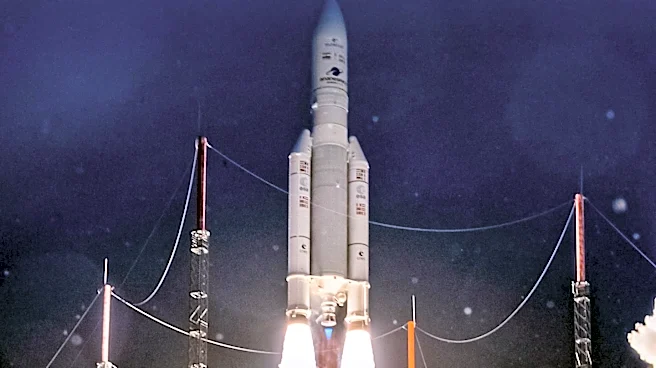
Amazon Leo, formerly known as Project Kuiper, is scheduled to resume satellite deployment on November 23, 2026, with its LE-04 mission aboard an Arianespace Ariane 64. The liftoff is targeted for 11:09 UTC into low Earth orbit. As of November 23, 2026, Amazon Leo had
placed 396 production satellites into orbit. The company aims to begin initial consumer service before the end of 2026 in the U.S., UK, France, Germany, and Canada, with selected businesses having tested an enterprise preview since November 2025. This launch follows Amazon missing its Federal Communications Commission (FCC) interim milestone of 1,616 working satellites by July 30, 2026. A conditional waiver granted on June 5, 2026, has kept its license in force, but all 3,232 first-generation satellites are still due by July 30, 2029.
Why It's Important?
The successful deployment of satellites for Amazon Leo is crucial for Amazon's entry into the competitive broadband internet market, directly challenging existing providers like Starlink. Missing the FCC's interim milestone could have significant regulatory and commercial consequences, as satellites launched after July 30, 2026, will have lower spectrum priority until Amazon reaches the 1,616-satellite threshold. This lower priority could impact the quality and reliability of service, potentially hindering Amazon's ability to attract and retain customers. The project represents a substantial investment by Amazon into space-based internet infrastructure, aiming to provide broadband access to underserved areas and compete in a rapidly expanding sector. The timely deployment and operationalization of these satellites are vital for Amazon to meet its regulatory obligations and achieve its commercial objectives in the global internet service market.
What's Next?
Amazon Leo's immediate next step is the successful launch of its LE-04 mission aboard the Ariane 64. Following this, the company will need to continue its aggressive satellite deployment schedule to meet the FCC's ultimate deadline of 3,232 first-generation satellites by July 30, 2029. The conditional waiver from the FCC provides a temporary reprieve, but the pressure remains to accelerate deployment to avoid further regulatory penalties and ensure spectrum priority. The company will also focus on expanding its enterprise preview and preparing for the full consumer service launch by the end of 2026. The performance of these newly launched satellites and their integration into the existing constellation will be closely monitored, as will the competitive landscape with other low Earth orbit broadband providers.
Beyond the Headlines
The challenges faced by Amazon Leo, particularly in meeting regulatory deployment deadlines, highlight the complexities and high stakes involved in large-scale satellite constellation projects. The concept of spectrum priority, where earlier deployments receive preferential treatment, underscores the critical role of regulatory bodies like the FCC in shaping the commercial viability of space-based ventures. This situation could set precedents for how future mega-constellations are regulated and how companies are held accountable for their deployment timelines. Furthermore, the increasing number of active satellites in orbit, as noted by Orbital Radar tracking data, raises broader concerns about orbital traffic management and the potential for collisions, emphasizing the need for robust space situational awareness tools and international cooperation to ensure the long-term sustainability of space activities.