




What's Happening?
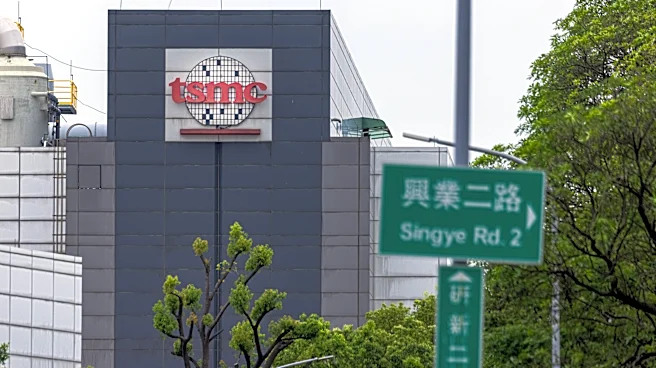
C.C. Wei, CEO of Taiwan Semiconductor Manufacturing Company (TSMC), has outlined the company's production schedule for its A14 chips. TSMC anticipates commencing A14 risk production in 2027, with volume production slated for 2028. Wei noted that customer
engagement for the A14 process is currently higher than what was observed for the 2nm activities. This announcement comes as TSMC continues to dominate the advanced chip manufacturing sector, with high-performance computing, including AI accelerators and server chips, constituting 68% of its revenue. The company reported strong third-quarter results, with revenue reaching $46.72 billion, and has raised its full-year growth outlook to approximately 44%. Despite strong demand in AI, TSMC acknowledges ongoing challenges in consumer and price-sensitive end-market segments due to rising component prices and broader economic uncertainties.
Why It's Important?
TSMC's aggressive timeline for A14 chip production and the reported high customer interest underscore its continued leadership in the global semiconductor industry. This is particularly significant as advanced chips are crucial for artificial intelligence development, high-performance computing, and various technological innovations. The company's ability to maintain its technological edge and production capacity directly impacts the supply chain for major U.S. tech companies that rely on TSMC for their cutting-edge processors. Intel, a key competitor, is targeting its 14A process for the same 2028 timeframe, highlighting the intense competition in the foundry market. TSMC's robust financial performance and substantial capital expenditure budget, significantly larger than Intel's, position it to maintain its lead, ensuring a steady supply of advanced semiconductors vital for U.S. technological advancement and economic competitiveness.
What's Next?
TSMC will proceed with its A14 risk production in 2027, followed by volume production in 2028. The company will likely continue to monitor global economic conditions and component prices, which are impacting consumer and price-sensitive markets. Intel is expected to release its 1.0 PDK for 14A by Q1 next year, after which customer discussions for product development will commence. The coming quarters will be critical for Intel to secure significant external 14A customers to challenge TSMC's dominance. The ongoing competition between TSMC and Intel in advanced chip manufacturing will shape the future landscape of the semiconductor industry, influencing technology development and supply chain stability for years to come.
Beyond the Headlines
The sustained demand for TSMC's advanced chips, particularly for AI applications, highlights a broader global reliance on specialized semiconductor manufacturing capabilities. This concentration of advanced chip production in a few key players, primarily TSMC, raises strategic concerns for nations like the U.S. regarding supply chain resilience and technological independence. The U.S. government's efforts to encourage domestic chip manufacturing, such as TSMC's Arizona facilities, aim to mitigate these risks. However, the sheer scale of investment and technological expertise required means that TSMC's role will remain pivotal for the foreseeable future, influencing national security, economic policy, and the pace of technological innovation globally.