






What's Happening?
UiPath Inc. (NYSE: PATH), a developer of enterprise automation software, is focusing on reaccelerating growth through AI-powered orchestration and an expanded platform strategy. The company recently reported improving financial momentum, with its Annual
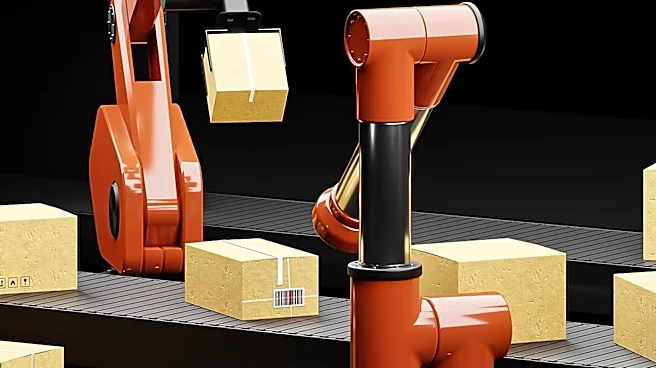
Recurring Revenue (ARR) reaching $1.938 billion, marking a 12.5% increase, and overall revenue rising by 13%. UiPath has achieved GAAP profitability for three consecutive quarters and anticipates full-year GAAP profitability, generating over $400 million in free cash flow. The company's strategy involves moving beyond traditional Robotic Process Automation (RPA) by integrating its Maestro orchestration product, advanced AI capabilities, and specialized vertical solutions. Notably, 18 of its 20 largest recent deals included broader AI-related platform capabilities, indicating a shift towards more comprehensive automation solutions. UiPath is also exploring diverse commercial strategies, including subscription, consumption, and potentially outcome-based pricing models, while supporting cloud, hybrid, and on-premise deployments.
Why It's Important?
This strategic shift by UiPath is significant for the U.S. business landscape as it reflects the growing demand for sophisticated automation solutions that leverage artificial intelligence. By expanding beyond basic RPA, UiPath is addressing the increasing complexity of enterprise business processes and the need for more intelligent, adaptive automation. The integration of AI and orchestration capabilities can lead to substantial efficiency gains, cost reductions, and improved operational resilience for U.S. companies across various sectors, including finance, customer service, human resources, and IT. The company's strong financial performance, including consistent GAAP profitability and significant free cash flow, demonstrates its stability and capacity to invest in further innovation, which can benefit its U.S. customer base. Furthermore, UiPath's model-agnostic approach to AI allows businesses to integrate their preferred AI models, offering flexibility and potentially accelerating the adoption of AI-driven automation across diverse enterprise environments.
What's Next?
UiPath plans to continue prioritizing internal product development while remaining open to selective acquisitions that can enhance its technology or vertical expertise. The company aims to further stabilize and reaccelerate growth by focusing on its platform strategy, developing more vertical-specific products, and expanding its testing offerings. UiPath will also continue to broaden its commercial strategies, potentially implementing outcome-based pricing for large transformation projects, which could align its incentives more closely with customer success. The company's emphasis on managing long-running enterprise workflows, rather than just isolated tasks, suggests a future where automation plays a more central and integrated role in business operations. As enterprises increasingly seek to coordinate robots, AI agents, employees, and various systems, UiPath's Maestro orchestration product is expected to be a key component in facilitating these complex, end-to-end workflows.
Beyond the Headlines
The evolution of UiPath from an RPA provider to a broader business automation and transformation platform highlights a fundamental shift in how U.S. enterprises are approaching digital transformation. The move towards 'agentic automation' and intelligent automation solutions, where AI agents perform reasoning and decision-making while robots handle execution, signifies a deeper integration of AI into the operational fabric of businesses. This trend raises important considerations regarding workforce adaptation, as employees will increasingly collaborate with intelligent automation systems. The ethical implications of AI-driven decision-making in business processes, as well as the need for robust governance and AI guardrails for secure and compliant automation execution, will become paramount. UiPath's focus on vertical expertise also suggests a future where automation solutions are highly tailored to specific industry needs, potentially leading to specialized AI applications that address unique challenges in sectors like healthcare and finance.