






What's Happening?
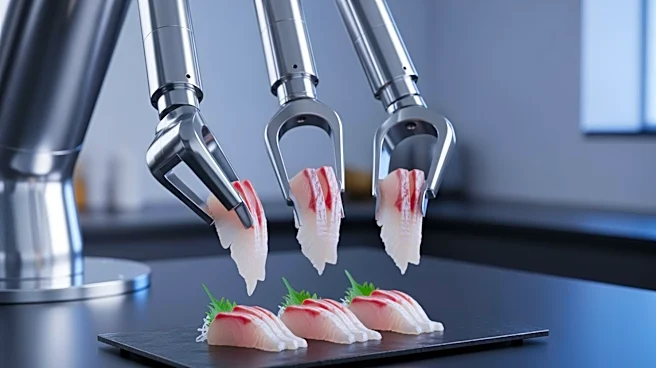
Researchers at the Norwegian University of Science and Technology have developed the Sashimi-Bot, a three-armed robotic system designed to autonomously prepare sashimi. This robot addresses the challenge of handling and slicing slippery, deformable objects
like fish. Each arm of the robot performs a specific task: one straightens the fish, another slices it, and the third places the slices on a tray. The system uses AI software to learn from experience, running virtual simulations to perfect its technique. Machine learning is employed to give the cutting arm a sense of touch, allowing it to adjust its cutting trajectory in real time.
Why It's Important?
The development of the Sashimi-Bot represents a significant advancement in robotic manipulation of delicate and deformable objects. This technology could have wide-ranging applications beyond food preparation, such as sorting soft items in recycling facilities or assisting in medical procedures involving soft tissues. By automating these tasks, the Sashimi-Bot could improve efficiency and precision in industries that require handling of fragile materials. This innovation also highlights the potential for AI and robotics to transform traditional industries, offering new solutions to complex problems.
What's Next?
The successful implementation of the Sashimi-Bot could lead to further research and development in robotic systems capable of handling a variety of delicate tasks. Industries such as food processing, recycling, and healthcare may explore similar technologies to enhance their operations. As the technology matures, it could lead to increased adoption of robotics in areas that require precision and care, potentially reshaping labor dynamics and operational processes in these sectors.