






What's Happening?
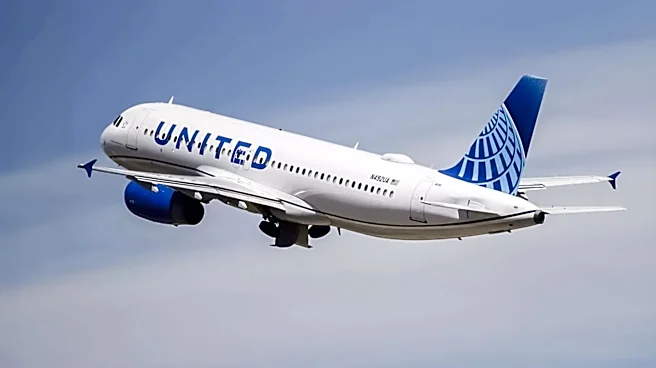
United Airlines' stock is currently trading at 9.5 times earnings, which is less than half the 22.6 times earnings for the median S&P 500 company. Over the past year, United shares have returned 5.4%, significantly trailing the S&P 500's 15.0% return,
even as the airline's sales and net income have increased. The company's revenue rose 12.3% in the twelve months leading up to September 30, 2026, surpassing the 8.5% growth for the median S&P 500 company and its own three-period average of 7.7%. Despite this sales growth, United's operating margin has slipped, recording 6.4% in the twelve months to September 30, 2026, down from 8.8% a year earlier. This decline indicates that costs grew faster than sales, with operating income falling to $4.17 billion from $5.17 billion over the same period. Management attributed a significant portion of increased costs to a $1.8 billion rise in fuel expense in fiscal Q3 2026.
Why It's Important?
The disparity between United Airlines' sales growth and its stock performance, coupled with declining operating margins, highlights a critical challenge for the airline industry: managing costs in an environment of fluctuating fuel prices and rising operational expenses. While United is successfully increasing its revenue, its inability to translate this into proportional profit growth, as evidenced by the lower operating margin, impacts investor confidence and stock valuation. The company's debt, which is approximately equal to its market value (100.8% at October 27, 2026, compared to 19.4% for the S&P 500), further complicates its financial health and investment appeal. This situation suggests that even strong sales performance may not be enough to drive stock appreciation if underlying cost structures are not effectively managed. For investors, this indicates that a bet on United Airlines is less about an overlooked sound business and more about the company's ability to address its cost challenges and improve profitability per dollar of sales.
What's Next?
United Airlines management has set ambitious targets for 2027, aiming to recover 100% of the rise in fuel costs and targeting 2% to 3% growth in cost per seat mile excluding fuel. The company also seeks to achieve double-digit pretax margins. For fiscal Q4 2026, management expects earnings per share to be between $0.50 and $1.50, a decrease from $2.54 per share in fiscal Q3. The operating margin in the fiscal Q4 2026 report, expected in January 2027, will be a key indicator for investors. Achieving these goals, according to management, will likely require lower fuel prices, reduced industry capacity, or other airlines accepting emptier planes for higher fares, indicating that some solutions are beyond United's direct control. The company is also exploring revenue-boosting initiatives like adding Starlink Wi-Fi to its jets, though it acknowledges this alone may not be sufficient to meet its financial targets.
Beyond the Headlines
The challenges faced by United Airlines, particularly the struggle to maintain operating margins despite robust sales, reflect broader economic pressures on the airline industry. The reliance on external factors like fuel prices and industry capacity for profitability underscores the inherent volatility and sensitivity of airline operations to global economic conditions. The company's high debt-to-market value ratio also points to a common issue within capital-intensive industries, where significant investments in aircraft and infrastructure often lead to substantial financial leverage. This situation could influence future investment strategies across the sector, potentially leading to more conservative expansion plans or increased focus on cost-cutting measures. The emphasis on 'winning back' fuel cost increases suggests a continuous battle for airlines to pass on rising expenses to consumers without deterring demand, highlighting the delicate balance between pricing power and market competitiveness.