





What's Happening?
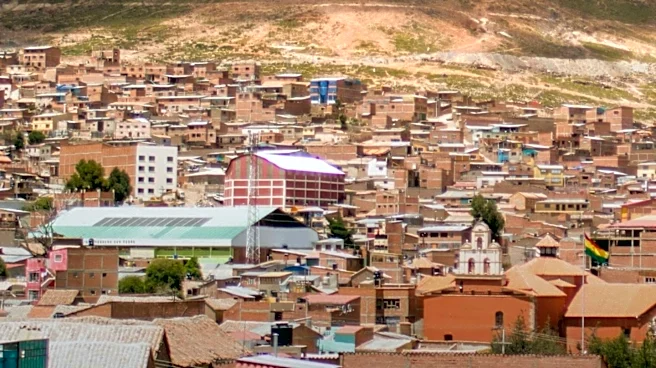
Entel, Bolivia’s state-owned telecommunications company, announced an investment of US$5,968,941 in Potosí, a mining city and department in Bolivia, through September 2026. This announcement was made by General Manager Jorge del Solar at the Potosí International
Fair on November 11, 2026. According to Entel, this investment supports approximately 530,000 mobile and home-fiber customers in the region, where the company claims a market share exceeding 75%. The company also stated that its mobile coverage reaches 97.75% of Potosí's inhabitants, with fiber-to-the-home services covering about 49,000 residences. The investment comes at a time when Bolivia's economy is contracting, with the International Monetary Fund (IMF) projecting a negative growth of 1.6% for 2025, as noted in its October 2026 World Economic Outlook.
Why It's Important?
This investment by Entel, while seemingly modest at US$6 million, is significant within the context of Bolivia's shrinking economy. The IMF's projection of negative growth for 2025 highlights the economic challenges facing the country. State-led investments in critical infrastructure like telecommunications can play a crucial role in stimulating local economies and improving connectivity, which is vital for business and social development. For the residents of Potosí, enhanced mobile and fiber-optic services could improve access to information, education, and economic opportunities, potentially mitigating some effects of the broader economic downturn. However, the lack of detailed breakdown regarding the investment's timeline, technology, or specific sites raises questions about its transparency and potential impact assessment. The company's strong market share in Potosí suggests a dominant position, which could influence competition and service innovation in the region.
What's Next?
The long-term impact of Entel's investment in Potosí will depend on how these funds are allocated and the specific technological advancements they facilitate. While the company has stated a goal of near full coverage by 2030, the current announcement lacks a yearly breakdown of the investment, making it difficult to track progress or assess immediate future developments. Future evaluations will likely focus on whether the investment translates into tangible improvements in service quality, network expansion, and customer satisfaction in Potosí. Given Bolivia's economic climate, any further state-backed initiatives or private sector responses to improve infrastructure will be closely watched. The transparency of such investments will be key for both local stakeholders and international observers, especially as the country navigates economic contraction.
Beyond the Headlines
The investment by Entel in Potosí, a region known for its mining history, underscores the broader shift towards digital infrastructure as a cornerstone of national development, even in traditional resource-based economies. The emphasis on mobile and fiber-to-the-home services reflects a global trend where connectivity is increasingly seen as a fundamental right and an economic enabler. However, the context of a shrinking national economy raises questions about the sustainability of such state-led investments and their potential to truly catalyze widespread economic recovery. The lack of detailed financial reporting from Entel, as highlighted by the source, points to a common challenge in state-owned enterprises regarding transparency and accountability, which can affect investor confidence and public trust. This situation also highlights the digital divide within countries, where even significant investments may not uniformly benefit all populations without strategic planning and oversight.