








What's Happening?
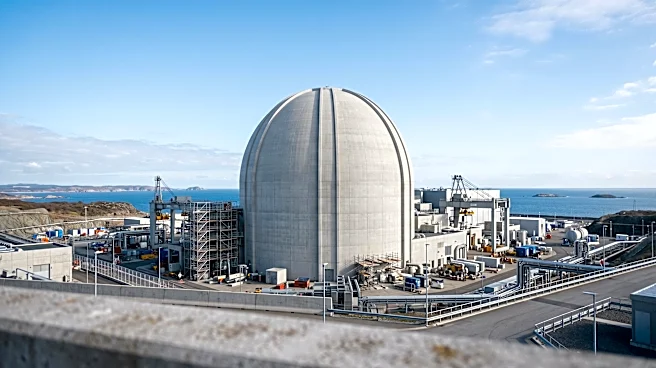
Poland's energy ministry has signed an agreement with state-owned companies Polskie Elektrownie Jądrowe (PEJ) and Polska Grupa Energetyczna (PGE) to prepare for the construction of a second nuclear power plant. This initiative is part of Poland's strategy
to enhance energy security and reduce reliance on external suppliers. PEJ will act as the investor and coordinator, while PGE, the country's largest power producer, will conduct preliminary feasibility studies and analyze potential locations. The project aims to transition Poland away from coal, which currently accounts for approximately half of its electricity generation, towards cleaner energy sources like nuclear and renewables. The construction of the second plant is projected to begin in 2032, with its first reactor potentially operational by 2040. A decision on selecting an international partner for the project, which includes U.S. company Westinghouse, is anticipated next year.
Why It's Important?
The potential involvement of U.S. company Westinghouse in Poland's second nuclear power plant project signifies a significant opportunity for American industry in the global energy sector. This collaboration could bolster U.S. influence in Central European energy infrastructure and provide a substantial economic boost through technology export and job creation. For Poland, the development of nuclear power is crucial for its energy independence and environmental goals, as it seeks to drastically reduce its reliance on coal. The project aligns with broader European efforts to diversify energy sources and achieve climate targets. The selection of a U.S. partner could also strengthen transatlantic alliances and technological cooperation, positioning American nuclear technology as a key solution for countries transitioning to cleaner energy. Conversely, a failure to secure this partnership could mean lost economic opportunities and a diminished role for U.S. companies in a growing international market for nuclear energy.
What's Next?
The immediate next step involves PGE preparing preliminary feasibility studies and analyzing potential sites for the second nuclear power plant. A critical decision expected next year will be the selection of an international partner for the project. U.S. company Westinghouse is among the candidates, alongside France’s EDF and Canada’s AtkinsRéalis. Once a partner is chosen, they will collaborate with PGE to further analyze potential sites, with current preferred locations being Bełchatów and Konin due to existing energy infrastructure. Construction of the plant is scheduled to commence in 2032, with the first reactor projected to begin service in 2040. This timeline is part of Poland's updated nuclear strategy, which also includes the first nuclear plant beginning operation in 2036. The outcome of the partner selection will determine the specific technological and operational framework for this major energy infrastructure project.
Beyond the Headlines
This project extends beyond mere energy production, touching upon geopolitical strategies and long-term energy security for Poland and potentially the broader European Union. By investing in nuclear power, Poland aims to reduce its vulnerability to fluctuations in global fossil fuel markets and diminish reliance on specific energy suppliers, thereby enhancing its national sovereignty. The involvement of a U.S. company like Westinghouse could also serve as a strategic counterweight to other international influences in the region, reinforcing Western technological standards and safety protocols in nuclear energy. Furthermore, the shift from coal to nuclear power represents a profound environmental commitment, aligning Poland with global climate action goals and potentially setting a precedent for other coal-dependent nations. The successful implementation of such a large-scale nuclear project could redefine Poland's industrial landscape and its role in the European energy transition.