





What's Happening?
BlackBerry, a company historically known for its smartphones, is undergoing a significant transformation, concentrating its efforts on foundational embedded software for physical artificial intelligence (AI) and software-defined vehicles. The company's
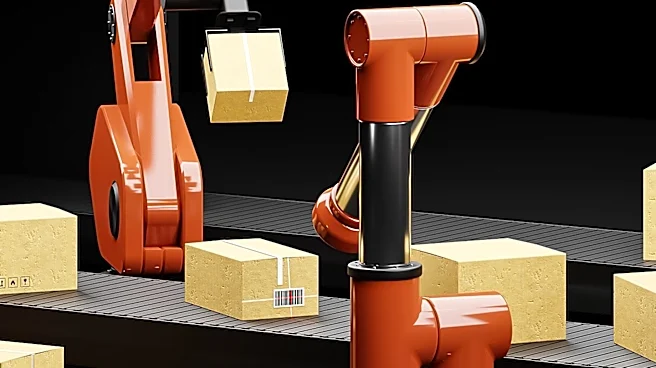
QNX software is already integrated into over 275 million vehicles globally, underpinning critical functions from braking to advanced driver-assistance systems. This strategic pivot aims to leverage BlackBerry's expertise in safety-critical automotive systems for broader applications in physical AI, where AI controls machines interacting with the real world. This includes robots in warehouses, autonomous forklifts, and medical equipment that demand high reliability and rapid response times. BlackBerry's CEO, John Giamatteo, highlighted robotics as a rapidly expanding area within QNX, focusing on automated mobile robots and industrial equipment. The company is also strengthening its proposition through a strategic relationship with NVIDIA, which has standardized on QNX for its Halos Safety Stack, creating opportunities across physical AI and autonomous machinery. Demonstrations planned for CES 2027 will showcase advancements in physical AI, robotics, and next-generation software-defined vehicles, including a Physical AI Studio designed to bridge the gap between experimental AI and robust deployment in real-world environments.
Why It's Important?
This strategic shift by BlackBerry is significant as it positions the company at the forefront of the evolving physical AI and software-defined vehicle markets, which are crucial for the future of manufacturing, logistics, and transportation. By focusing on the underlying software infrastructure, BlackBerry aims to provide the reliable and secure operating systems necessary for machines that perceive, decide, and act in physical environments. This move could have a substantial impact on industries requiring high levels of automation and safety, such as automotive, industrial robotics, and healthcare. The increasing demand for predictable and reliable machine operations in these sectors creates a significant market opportunity for BlackBerry's QNX software. Furthermore, the collaboration with NVIDIA underscores the industry's recognition of QNX's capabilities in safety-critical applications, potentially accelerating the adoption of BlackBerry's technology in autonomous systems. The development of tools like Physical AI Studio is vital for enabling the practical deployment of AI in real-world scenarios, addressing the gap between theoretical AI models and functional, dependable machines.
What's Next?
BlackBerry is set to provide a clearer indication of its progress and future direction at CES 2027, where it plans to showcase demonstrations of physical AI, robotics, and next-generation software-defined vehicles. These demonstrations will include robot arms running on Raspberry Pi hardware for accessible physical AI development, and a Flexiv industrial robot demonstrating human movement imitation with obstacle response. A key highlight will be the Physical AI Studio, which combines AI perception, generative AI, robotics simulators, and QNX OS 8, aiming to facilitate the deployment of robust AI systems in real environments. In the automotive sector, QNX Cabin is designed to enable developers to integrate and test digital-cockpit software in the cloud before vehicle hardware is available. Additionally, BlackBerry's secure communications business continues to expand, with the Government of Canada extending its agreement for BlackBerry SecuSUITE through 2033, emphasizing digital sovereignty and expanding deployment to the Department of National Defence. These developments indicate a continued focus on both secure communications and reliable machine operations.
Beyond the Headlines
BlackBerry's transformation signifies a deeper trend in the technology industry: the increasing convergence of AI with physical systems, moving beyond purely digital applications. This shift raises important ethical and safety considerations, particularly as AI-controlled machines become more integrated into critical infrastructure and daily life. The emphasis on safety-critical computing, a core strength of BlackBerry's QNX, will be paramount in ensuring the reliability and trustworthiness of these advanced systems. The concept of 'digital sovereignty,' highlighted by the Canadian government's extended agreement for BlackBerry SecuSUITE, also points to a growing global concern over data control and security, especially for sensitive governmental information. As machines become more autonomous and interconnected, the underlying software's ability to manage failures safely and maintain secure communications will be crucial. BlackBerry's strategy to embed its software invisibly within these systems suggests a future where its technology is deeply integrated into the fabric of modern society, even if its brand is not overtly visible to end-users.