









What's Happening?
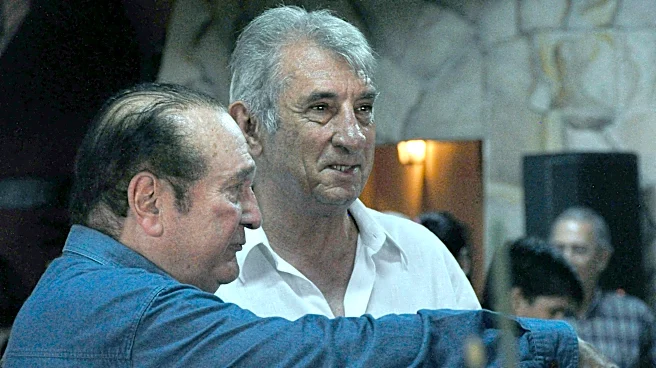
Antonio Rattín, a former Argentine footballer known for his influential role in the 1966 World Cup, has died at the age of 89. Rattín, who played as a defensive midfielder for Boca Juniors and the Argentine national team, was a key figure in the introduction
of yellow and red cards in football. During the 1966 World Cup quarterfinals against England, Rattín was sent off for verbal dissent, a decision that was not clearly communicated due to the lack of visual signals for fouls at the time. His protest, which included sitting on the red carpet reserved for Queen Elizabeth II, led to a significant change in how referees communicate with players. This incident prompted FIFA to adopt the yellow and red card system, inspired by traffic lights, to clearly indicate cautions and dismissals.
Why It's Important?
Rattín's actions during the 1966 World Cup had a lasting impact on the sport of football, leading to a fundamental change in how the game is officiated. The introduction of yellow and red cards has become a universal standard, improving clarity and fairness in the enforcement of rules. This change not only enhanced the game's integrity but also helped manage the increasingly physical nature of football. Rattín's legacy extends beyond his playing career, as his influence is felt in every match where these cards are used. His defiance also intensified the football rivalry between Argentina and England, adding a historical dimension to their encounters.
What's Next?
As Argentina continues to compete in international tournaments, the legacy of players like Rattín remains a source of national pride. The current Argentine team is participating in the World Cup, with hopes of advancing to the semifinals. The historical rivalry with England, partly fueled by Rattín's actions, continues to be a significant narrative in international football. The use of yellow and red cards, now a staple in the sport, will continue to play a crucial role in maintaining discipline and fairness on the field.
Beyond the Headlines
Rattín's story highlights the broader cultural and historical connections between sports and national identity. His actions at the 1966 World Cup not only changed the rules of football but also contributed to the narrative of Argentina's sporting history. The rivalry with England, intensified by Rattín's protest, reflects deeper geopolitical tensions and cultural exchanges. This incident underscores how sports can serve as a platform for broader societal issues, influencing perceptions and relationships between nations.