




What's Happening?
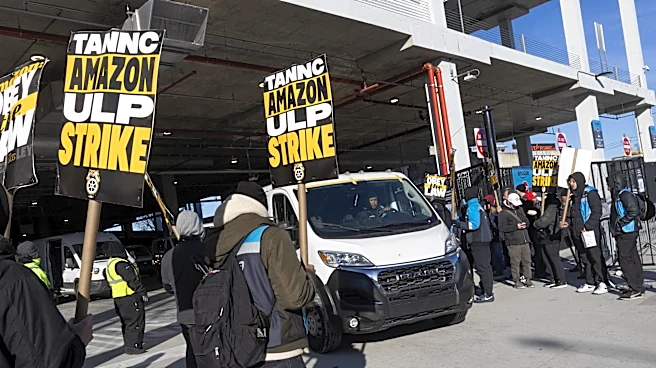
Trade union leaders from 19 countries, coordinated by UNI Global Union, are calling on governments to cease awarding public contracts to Amazon and Amazon Web Services (AWS). This appeal follows a year in which U.S. federal agencies committed over $3.5
billion to AWS. The unions assert that Amazon has a documented history of violating workers' fundamental rights, both within and outside the United States. Examples cited include Amazon's legal challenges to the National Labor Relations Board's structure in an attempt to prevent Teamsters' proceedings, its refusal of collective bargaining in Germany despite prolonged strikes, and the closure of operations in Quebec when workers organized. The open letter, made public ahead of Black Friday, urges governments to review existing and planned contracts, making respect for workers' rights a mandatory condition for contract eligibility and excluding non-compliant companies from future public tenders.
Why It's Important?
This coordinated international effort highlights a growing tension between corporate practices and labor rights, particularly concerning large multinational corporations like Amazon. For the U.S., the significant federal spending on AWS contracts, such as the $581 million for the Air Force's Cloud One program and the $2.56 billion for the Department of Homeland Security, indicates a substantial reliance on Amazon's services. If governments heed the unions' call, it could lead to a re-evaluation of procurement policies, potentially impacting Amazon's revenue from public sector contracts. This could also set a precedent for other companies, forcing them to prioritize labor rights to secure government business. The move underscores the increasing scrutiny on corporate social responsibility and could influence public perception and consumer behavior, especially during major shopping events like Black Friday.
What's Next?
The unions are pushing for governments to implement stricter conditions for public contracts, requiring companies to demonstrate respect for workers' rights. This could lead to legislative or policy changes in various countries, including the U.S., regarding how government contracts are awarded. Amazon may face increased pressure to address the alleged labor violations to maintain its access to lucrative public sector business. The European Commission's proposal for a Public Procurement Act, which aims to replace existing directives with a single regulation, could also influence how labor standards are integrated into procurement processes globally. The ongoing 'Make Amazon Pay Day' protests indicate continued activism and public pressure on the company's labor practices.
Beyond the Headlines
The campaign by UNI Global Union and its affiliates points to a broader debate about the ethical responsibilities of governments when engaging with private corporations. It raises questions about whether public funds should be directed towards companies accused of undermining labor protections. This initiative could contribute to a global shift in procurement standards, where social and labor clauses become as critical as economic and technical criteria. The focus on Amazon, a dominant player in e-commerce and cloud services, could also inspire similar actions against other large corporations, potentially reshaping the landscape of global labor relations and corporate accountability. The argument that taxpayers are inadvertently funding practices that suppress workers' rights adds a moral dimension to the economic and political considerations.