



What's Happening?
Zhipu AI (ZHIPU) has experienced a significant decline in its stock value, falling as much as 85% from its June peak. The company's shares were recently quoted at $41.35, marking an 8.62% drop over 24 hours. This downturn is part of a broader negative
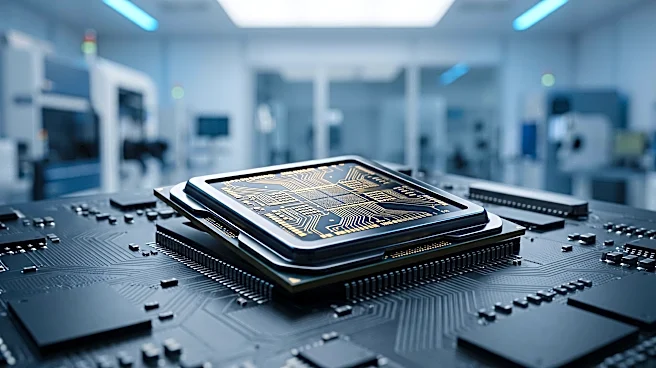
trend, with the stock trading below its 7-day, 20-day, and 50-day moving averages, indicating sustained pressure on its medium-term structure. The technical analysis suggests oversold conditions, yet the bearish momentum persists. This financial struggle for Zhipu AI is occurring within a wider context where Chinese AI firms are facing increasing difficulties in securing capital compared to their U.S. counterparts. Between 2023 and 2026, U.S. AI firms raised approximately $380 billion in venture funding, while Chinese startups secured about $39 billion. Additionally, tighter U.S. export controls on advanced chips, particularly from Nvidia, are expected to lead to higher costs and slower model development for Chinese AI companies.
Why It's Important?
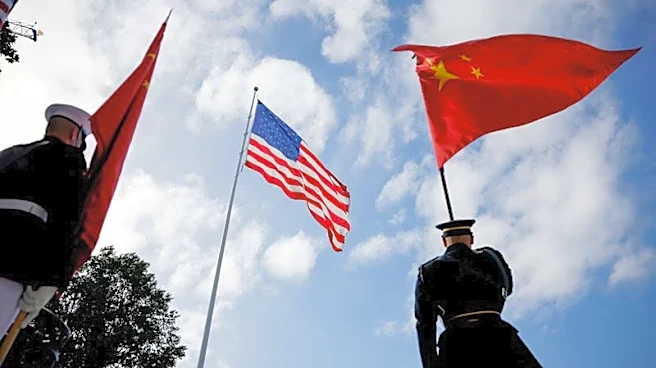
The struggles of Zhipu AI and other Chinese AI firms highlight a growing capital and technological divide in the global artificial intelligence race, with significant implications for U.S. industries and policy. The substantial funding gap, where U.S. AI firms have raised nearly ten times more venture capital than Chinese startups in recent years, positions American companies for accelerated growth and innovation. This disparity is further exacerbated by U.S. regulatory actions, such as export controls on advanced chips, which aim to limit China's access to critical hardware necessary for training sophisticated AI models. For U.S. technology companies, particularly chip manufacturers like Nvidia, these restrictions reinforce their market dominance and strategic importance. Conversely, Chinese AI firms face increased operational costs and slower development cycles, potentially hindering their ability to compete globally. This situation underscores the effectiveness of U.S. policy in shaping the competitive landscape of the AI sector, creating a more favorable environment for American innovation while posing significant challenges for Chinese competitors.
What's Next?
The immediate future for Zhipu AI and similar Chinese AI firms will likely involve continued financial pressure and strategic adjustments. Investors will be closely monitoring upcoming earnings reports from major Chinese tech companies like Alibaba and Baidu for further indications of strain on margins and cash flow due to AI investments. The effectiveness of U.S. chip restrictions will also be a key factor; Chinese firms will need to adapt to these curbs, potentially by exploring alternative hardware solutions or developing their own chip capabilities, which could be a long-term and costly endeavor. There is also a question of whether recent large domestic funding rounds, such as DeepSeek's $15 billion in October 2026, will prove to be isolated incidents or signal a new trend of significant internal investment to counter the external funding gap. The ongoing U.S.-China competition in AI is expected to intensify, with both nations continuing to implement policies aimed at fostering their domestic AI ecosystems while potentially hindering their rivals.
Beyond the Headlines
The financial and technological pressures on Chinese AI firms like Zhipu AI extend beyond immediate market performance, touching upon broader geopolitical and ethical considerations. The widening gap in AI funding and chip access reflects a strategic competition between the U.S. and China for technological supremacy, which has implications for national security, economic influence, and future innovation. The U.S. policy of restricting access to advanced chips raises questions about the long-term impact on global technological collaboration and the potential for a bifurcated AI ecosystem. Ethically, these restrictions could be seen as limiting technological advancement in certain regions, potentially slowing down global progress in areas where AI could offer significant benefits. Culturally, the narrative of a 'tech race' could foster increased nationalism and protectionism, potentially hindering the open exchange of scientific knowledge and talent that has historically driven innovation. The long-term shifts could include a greater emphasis on indigenous technological development in China and a re-evaluation of global supply chains for critical components, leading to a more fragmented and competitive international technology landscape.