







What's Happening?
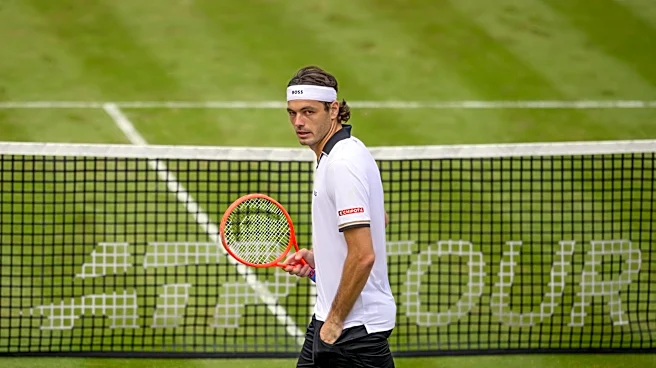
Taylor Fritz and Alex de Minaur, despite not qualifying for the ATP Finals, are set to receive $156,000 each as alternates for the tournament. Both players have been consistent participants in the year-end event in recent years, with Fritz competing in three
of the last four years and de Minaur in the last two, even reaching the semifinals in 2025. As alternates, they are required to be present in Turin, Italy, to assist with practice sessions for the eight qualified players and be available to step in if any player withdraws due to injury. This payment significantly surpasses the prize money for winning other tournaments, such as the Stockholm Open, where a victory would yield $128,016 for Fritz. The role ensures they remain prepared and offers a substantial financial benefit without necessarily playing a competitive match.
Why It's Important?
This arrangement highlights a significant financial incentive for top-ranked tennis players, even when they don't secure a direct qualification spot for prestigious tournaments like the ATP Finals. The $156,000 payout for being an alternate underscores the economic value placed on having high-caliber players on standby, ensuring the integrity and competitive level of the event in case of unforeseen withdrawals. For players like Fritz and de Minaur, this provides a substantial income boost outside of Grand Slams and Masters 1000 events, contributing significantly to their annual earnings. It also allows them to maintain match readiness and potentially gain an advantage for future seasons by staying engaged with the elite competition environment, even if not actively competing.
What's Next?
Taylor Fritz will continue his season at the Stockholm Open, which he decided to play despite missing out on ATP Finals qualification. His participation in Stockholm, while not directly impacting his ATP Finals alternate status, keeps him sharp and competitive. Both Fritz and de Minaur will remain in Europe to fulfill their alternate duties in Turin. They will be on standby throughout the ATP Finals, ready to step in if any of the qualified players are unable to continue. Historically, alternates have been called upon in 15 instances over the last 30 years, with one notable example being David Nalbandian, who won the tournament as an alternate in 2005. Their presence ensures the tournament can proceed smoothly even with unexpected player changes.
Beyond the Headlines
The alternate system in professional tennis, particularly for high-stakes events like the ATP Finals, reveals the intricate balance between athletic performance, financial reward, and strategic career management. For players on the cusp of qualification, the alternate position offers a safety net and a significant financial reward, mitigating some of the disappointment of narrowly missing out. It also reflects the professionalization of the sport, where players are compensated not just for winning but also for their readiness and availability to maintain the event's quality. This system can influence players' end-of-season scheduling decisions, as staying in contention for an alternate spot can be more lucrative than competing in smaller tournaments, thereby shaping the competitive landscape of the tour.