


What's Happening?
Tesla is preparing to release its Full Self-Driving (FSD) v15 update next month, as confirmed by Elon Musk on X. This update is anticipated to be a significant advancement over previous versions, utilizing a larger model with approximately 10 billion
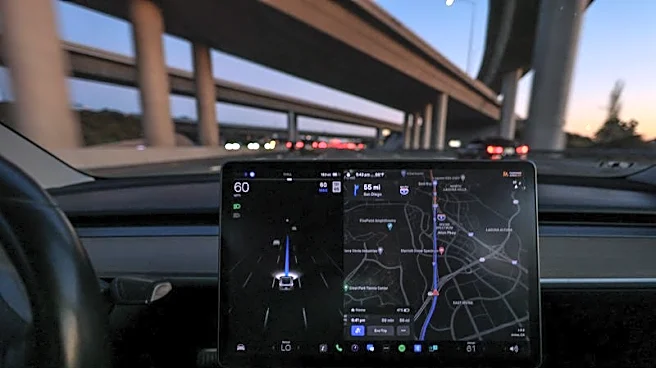
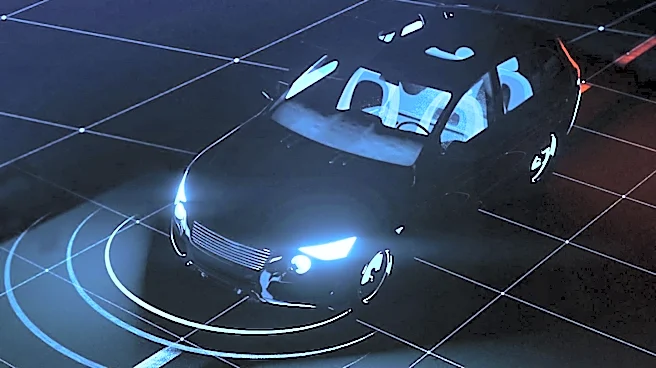
parameters, a substantial increase from the one billion in v14. Tesla VP of AI Ashok Elluswamy stated that v15 will introduce earlier hazard prediction, faster reaction times, and improved collision avoidance. Additionally, it will be the first FSD version to integrate Tesla's proprietary AI-based maps, initially for trip departures and arrivals. The update is also expected to address long-standing user requests, such as pothole avoidance and the ability to park in home garages. Musk hinted at a 'mind-bending' new user interface that will re-render reality, suggesting a more realistic FSD visualization.
Why It's Important?
The FSD v15 update holds significant implications for the automotive industry and the future of autonomous driving. The promised improvements in hazard prediction, reaction times, and collision avoidance could enhance vehicle safety, potentially reducing accidents and increasing public trust in self-driving technology. The integration of Tesla's own AI-based maps signifies a move towards greater independence from third-party mapping services, which could give Tesla a competitive edge and more control over its FSD system's performance. Features like pothole avoidance and home garage parking, while seemingly minor, address practical pain points for users and could significantly improve the daily usability and appeal of FSD. This release could also accelerate the deployment of Tesla's Robotaxi service, as Elluswamy previously indicated that v15 would enable 24/7 rides, potentially expanding autonomous ride-sharing services in more cities.
What's Next?
The FSD v15 update is scheduled for a wide release next month, likely coinciding with Tesla's annual holiday update. Following its consumer release, the update is expected to facilitate the broader expansion of Tesla's Robotaxi service. Tesla has previously stated that it would await FSD v15 before scaling up Robotaxi operations, suggesting that more cities could see the service introduced in 2027. The new user interface and enhanced visualization capabilities will be closely watched by users and industry observers to assess their impact on the driving experience. The performance of v15 in real-world scenarios, particularly regarding its new features like pothole avoidance and improved parking, will be critical in shaping public perception and regulatory discussions surrounding autonomous vehicles.
Beyond the Headlines
The FSD v15 update represents more than just a software upgrade; it signifies Tesla's continued push towards a fully autonomous future and its ambition to redefine personal transportation. The shift to a larger AI model with 10 billion parameters underscores the increasing complexity and sophistication of the algorithms powering self-driving cars, raising questions about the computational demands and ethical considerations of such advanced AI systems. The development of Tesla's own AI-based maps highlights a broader trend in the tech industry towards vertical integration, where companies seek to control more aspects of their technology stack. This could lead to a more closed ecosystem for Tesla's FSD, potentially impacting interoperability with other automotive technologies. The 'mind-bending' new user interface also suggests an evolving relationship between human drivers and autonomous systems, where the car's perception of reality is increasingly mediated through AI, potentially altering the driving experience in profound ways.