


What's Happening?
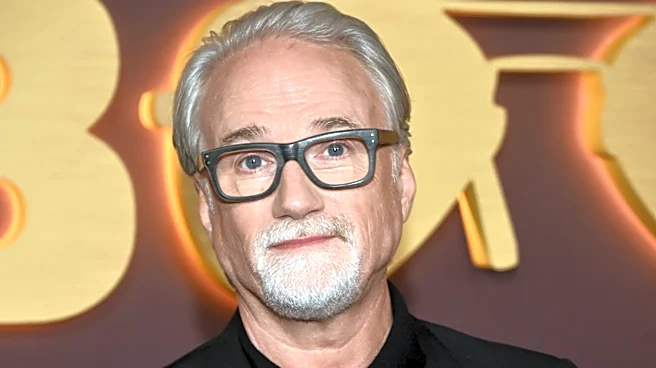
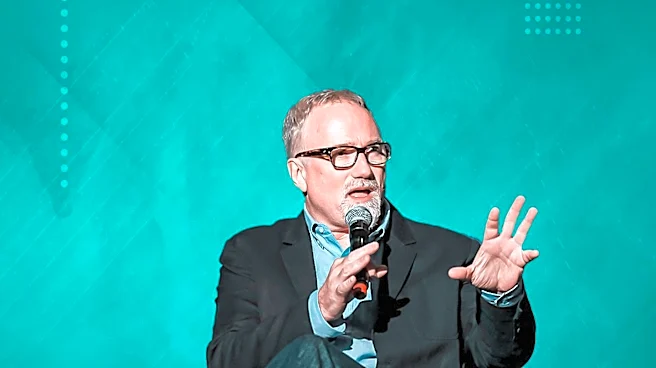
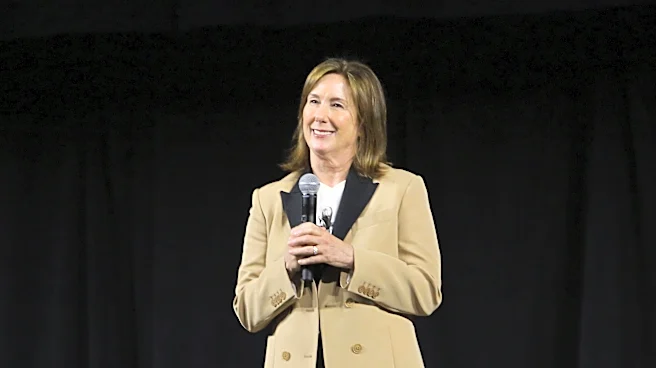
Filmmaker David Fincher recently revealed that he discussed the possibility of taking Lucasfilm public with Kathleen Kennedy before the company was sold to Disney in 2012. Fincher, known for his work on films like 'Fight Club' and 'The Social Network,'
suggested an initial public offering (IPO) to allow investors to determine the company's value. This revelation came during an interview where he also elaborated on his long-held concept for a 'Star Wars' film centered on the droids C-3PO and R2-D2, viewing them as 'slaves who would bear witness to the folly of man.' Fincher's connection to the 'Star Wars' franchise dates back to his early career at Industrial Light & Magic, where he worked on visual effects for 'Return Of The Jedi.' The IPO discussion was cut short when Kennedy informed him of a $7 billion offer on the table, which Fincher acknowledged they couldn't beat, though the actual sale price to Disney was approximately $4.05 billion.
Why It's Important?
This disclosure offers a unique glimpse into the pre-acquisition landscape of Lucasfilm and highlights a significant, albeit unrealized, alternative path for the company's future. Had Fincher's IPO suggestion been pursued, Lucasfilm's ownership structure and subsequent creative direction could have been vastly different, potentially impacting the 'Star Wars' franchise and other Lucasfilm properties. The idea of a publicly traded Lucasfilm, rather than one owned by a single corporate entity like Disney, could have led to different investment strategies, creative freedoms, and fan engagement models. It also underscores Fincher's broader concerns about the increasing consolidation within Hollywood, which he believes makes it more difficult to protect individual artistic voices. This perspective from a prominent director sheds light on the economic forces shaping the entertainment industry and the challenges faced by creators within a consolidating market.
What's Next?
While Fincher's proposal for an IPO did not materialize, his comments contribute to ongoing discussions about corporate consolidation in the entertainment industry. The 'Star Wars' franchise continues under Disney's ownership, with numerous films and series in various stages of development. Fincher himself continues his filmmaking career, often expressing his views on the industry's evolution. Although a Fincher-directed 'Star Wars' film remains an intriguing 'what if,' his detailed concept for a droid-centric story could inspire future creators within the franchise. The anecdote serves as a historical footnote to one of the most significant acquisitions in modern entertainment, offering a counterfactual scenario that could have reshaped a major Hollywood studio.
Beyond the Headlines
Fincher's fascination with C-3PO and R2-D2 as 'witnesses' to the 'Star Wars' saga offers a profound thematic interpretation of the franchise. By focusing on the droids' perspective as outsiders observing human conflicts, Fincher highlights themes of servitude, observation, and the moral ambiguities of power. This approach contrasts with the more hero-centric narratives typically associated with 'Star Wars,' suggesting a deeper, more philosophical exploration of the universe. His concern about the 'horrible constricting of the business' due to consolidation also points to a broader cultural debate about artistic independence versus corporate control in creative industries. This tension between commercial viability and artistic integrity is a recurring theme in Hollywood, and Fincher's anecdote provides a concrete example of how these forces play out at the highest levels of the industry.