




What's Happening?
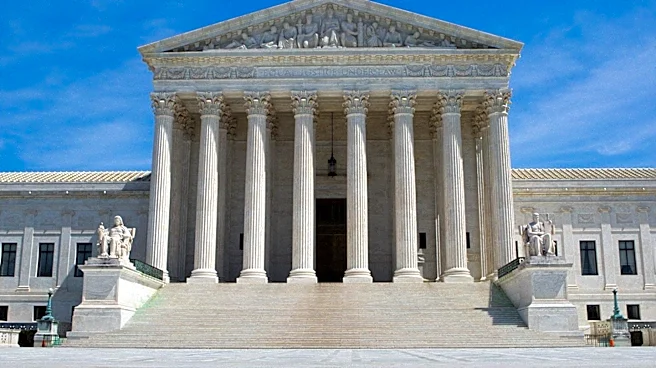
The National Football League (NFL) has formally requested the U.S. Supreme Court to promptly address the legal status of sports event contracts offered by prediction markets. The NFL's filing, submitted on Thursday, advocates for state-level regulation
of these markets, rather than federal oversight. This move comes after New Jersey petitioned the Supreme Court last month to intervene, following conflicting rulings from two different appeals courts regarding states' authority to enforce sports betting laws against prediction-market platforms. The NFL's brief highlights the significant trading volume in prediction markets, noting that on the first Sunday of the current season, over half of the $3.3 billion total trading volume—approximately $1.8 billion—was related to the NFL. A league source clarified that the NFL's action is not an opposition to prediction markets themselves, but rather a continuation of its campaign for integrity and consumer protection within a new legal forum. The league emphasizes the urgency for the Court to act due to the substantial financial activity and regulatory uncertainty surrounding these markets.
Why It's Important?
This development is significant for the U.S. sports betting industry, consumer protection, and the broader regulatory landscape. The NFL's stance underscores a growing concern among major sports leagues about the integrity of their games and the financial risks associated with unregulated or inconsistently regulated prediction markets. Unlike the NHL and MLB, which have partnered with prediction markets, the NFL has maintained its opposition, despite engaging in discussions with companies like Kalshi and Polymarket, and the Commodity Futures Trading Commission (CFTC). The league argues that existing safeguards for traditional sports betting, which are state-regulated, are more robust. The NFL's brief also criticizes the CFTC's proposed rules for the industry, deeming them insufficient to address risks such as market manipulation and consumer protection, particularly concerning the participation of individuals as young as 18 in some prediction markets, whereas most legalized sports betting requires users to be 21. The outcome of this Supreme Court review could establish a precedent for how prediction markets are regulated nationwide, impacting their operations, the financial services industry, and the integrity of professional sports.
What's Next?
The Supreme Court expert cited in the source indicates that it is uncertain when the Supreme Court will agree to hear the case, with January being the earliest possible timeframe. However, the process could be prolonged, potentially extending for months if the Court requests the Solicitor General to weigh in. Kalshi's response to the case is due by November 9. Even if the Court decides to take up the case in January, a final decision could be delayed until 2028. The NFL's brief suggests that if the CFTC and federally regulated exchanges were to implement safeguards comparable to those of state and tribal gambling regulators, concerns might be alleviated. However, the league asserts that this is not currently the case, criticizing what it perceives as a 'laissez-faire approach to regulation by the industry.' The CFTC, in response, stated its engagement with the NFL since day one in proposing new prediction-market rules and expressed regret that the NFL declined to sign a memorandum of understanding that would have facilitated better cooperation and information exchange.
Beyond the Headlines
The NFL's push for Supreme Court intervention highlights a deeper tension between innovation in financial markets and the need for robust regulatory oversight, particularly in emerging sectors like prediction markets. The debate over state versus federal regulation of these markets could have far-reaching implications for other nascent industries that operate across state lines but lack a clear, unified regulatory framework. The league's emphasis on 'integrity and consumer protection' also reflects a broader societal concern about the potential for manipulation and exploitation in financial products tied to public events, especially those involving sports. The involvement of 39 state attorneys general and 145 tribal nations and organizations in supporting New Jersey's petition underscores the widespread interest and potential impact of this case on diverse stakeholders. The outcome will not only shape the future of prediction markets but also influence how new forms of financial speculation are integrated into the existing legal and ethical landscape, potentially setting a precedent for how regulatory bodies adapt to rapidly evolving technological and economic trends.