




What's Happening?
S&P Global Ratings, a major credit rating agency, is considering downgrading Nvidia's credit rating from AA to AA-, citing concerns about the company's management and governance practices. According to TechCrunch, this potential downgrade stems from the recent
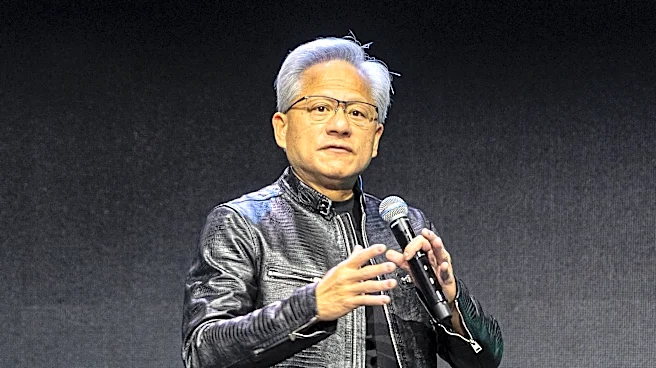
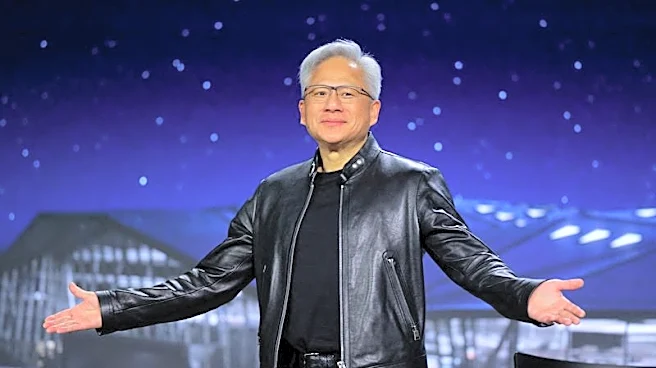
ouster and subsequent reinstatement of CEO Jensen Huang, which has raised questions about 'weak executive oversight and lack of succession planning' and 'key man risk,' indicating a heavy reliance on Huang for Nvidia's future success. Despite Nvidia's strong financial performance, S&P expects to complete its review within 90 days. While Nvidia is expected to maintain its investment-grade rating, a downgrade could increase its borrowing costs. This is particularly relevant as Nvidia plans to arrange $500 billion in financing for AI infrastructure, with the company guaranteeing a portion of these loans. Lenders have already been demanding larger guarantees, and a downgrade would likely intensify these demands.
Why It's Important?
A potential downgrade of Nvidia's credit rating, even within the investment-grade tier, carries significant implications for the company and the broader AI infrastructure market. Higher borrowing costs for Nvidia could impact its ambitious plans to finance AI infrastructure, potentially slowing down its expansion and investment in critical technologies. Furthermore, as Nvidia often backstops other infrastructure companies that lack strong credit, a lower rating could make debt costlier for these partners or require them to post more collateral. This ripple effect could affect the pace of AI development and deployment across various industries that rely on Nvidia's technology and ecosystem. The S&P's concerns about governance and 'key man' risk highlight the importance of stable leadership and robust succession planning in maintaining investor confidence, especially for a company at the forefront of a rapidly evolving and high-stakes technological sector like AI.
What's Next?
S&P Global Ratings is expected to conclude its review of Nvidia's credit rating within the next 90 days. During this period, Nvidia will likely face increased scrutiny from investors and financial institutions regarding its governance structure and succession plans. The company may need to demonstrate concrete steps to address the 'key man' risk associated with CEO Jensen Huang and assure stakeholders of its long-term stability. If a downgrade occurs, Nvidia's borrowing costs for its planned $500 billion AI infrastructure financing could increase, potentially leading to renegotiations with financial institutions like Goldman Sachs, Apollo, and Blackstone. This could also prompt other credit rating agencies to review Nvidia's standing. The outcome of this review will not only affect Nvidia's financial flexibility but also serve as a bellwether for how governance issues are perceived in the high-growth technology sector.
Beyond the Headlines
The S&P's consideration of a downgrade for Nvidia delves into the less tangible, yet profoundly impactful, aspects of corporate health: leadership stability and governance. In the fast-paced world of technology, where innovation often hinges on visionary leaders, the concept of 'key man risk' becomes particularly salient. This situation underscores a growing trend where financial markets are increasingly factoring in qualitative elements like corporate governance, ethical leadership, and succession planning alongside traditional financial metrics. For Nvidia, a company whose valuation is heavily tied to its pioneering role in AI, any perceived instability at the top can have outsized effects on investor confidence and market perception. This event could prompt other tech giants to re-evaluate their own governance structures and succession strategies, recognizing that even strong financial performance cannot fully insulate a company from the consequences of leadership uncertainties.