






What's Happening?
Stoke Space Technologies has successfully completed the initial closing of a $1 billion Series E funding round. This significant investment is earmarked to scale the company's operations, including infrastructure development, production, and increasing
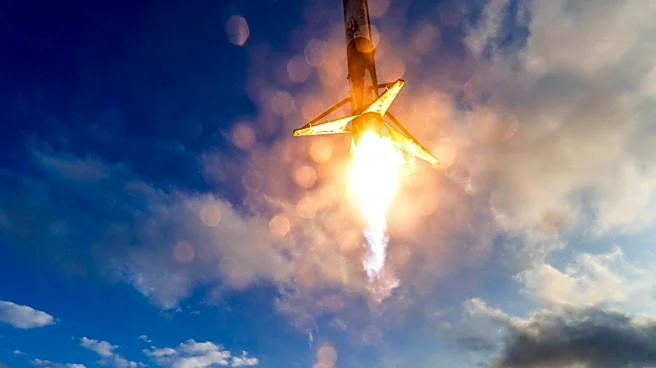
flight frequency. A key objective of this funding is to support the development of Stoke Space's second-generation rocket. The company aims to achieve fully reusable rocket technology, a feat that has not yet been accomplished, even by industry leader SpaceX. Stoke Space's approach involves a unique active cooling solution for its rocket's second stage, utilizing super-cooled liquid hydrogen to shield components from extreme reentry heat. This technology has undergone extensive ground testing and is slated for deployment in the company's initial flights. The funding round was led by Point72 Ventures and Spark Capital, with additional contributions from General Innovation, Glade Brook Capital, US Innovative Technology, Washington Harbour Partners, Woven Capital, and Y Combinator.
Why It's Important?
This substantial investment in Stoke Space signifies a growing competitive landscape in the U.S. space launch industry, traditionally dominated by SpaceX. The pursuit of fully reusable rockets, where both booster and payload-carrying stages return to Earth for cheap reuse, is considered the 'holy grail' for significantly reducing space access costs. If successful, Stoke Space's technology could democratize space access, making it more affordable for a wider range of commercial and governmental entities. This could accelerate the deployment of satellite constellations and other space-based applications, fostering innovation and economic growth in the space sector. The development of a viable alternative to SpaceX's offerings could also enhance national security by diversifying launch capabilities and reducing reliance on a single provider. Furthermore, the active cooling solution being pioneered by Stoke Space represents a significant technological advancement in thermal management for spacecraft reentry, with potential applications beyond rocketry.
What's Next?
Stoke Space anticipates the first flight of its Nova Pathfinder vehicle in early 2027. This initial rocket is designed to carry three metric tons to low-Earth orbit, which the company believes will be the largest debut vehicle for any U.S. rocket manufacturer. Following successful test-firing of each rocket stage on the ground, the next step involves integrating these components for combined testing. The company has already secured launch contracts for the Nova Pathfinder. Looking further ahead, Stoke Space plans to deploy an even larger rocket, the Nova Block 2, by 2029. This second-generation vehicle, based on the same core technologies, is projected to carry 15 metric tons to low-Earth orbit, potentially filling a market gap as SpaceX phases out its Falcon 9. The success of these upcoming tests and launches will be crucial in establishing Stoke Space as a formidable competitor in the reusable rocket market.
Beyond the Headlines
The race for fully reusable rocket technology extends beyond mere cost reduction; it represents a fundamental shift in how humanity interacts with space. Achieving full reusability could enable more frequent and routine space missions, transforming space travel from an extraordinary endeavor into a more accessible and sustainable activity. This could lead to an explosion of innovation in areas like in-orbit manufacturing, space tourism, and advanced scientific research. The development of robust thermal protection systems, such as Stoke Space's active cooling, is critical for the longevity and safety of reusable spacecraft, pushing the boundaries of material science and engineering. The increased competition in the space launch sector, fueled by companies like Stoke Space, could also drive down prices and foster greater efficiency, ultimately benefiting a wide array of industries that rely on space-based services. This technological frontier also raises ethical considerations regarding space debris and the long-term environmental impact of increased launch activity, which will require careful consideration as the industry evolves.