







What's Happening?
VinFast Auto Ltd., a Singapore-based company listed on Nasdaq, has fully divested its 100% capital from VinFast Production and Business Joint Stock Company (VFTP) in Vietnam. Previously, VinFast Auto held 10.369% of VFTP's charter capital, valued at approximately
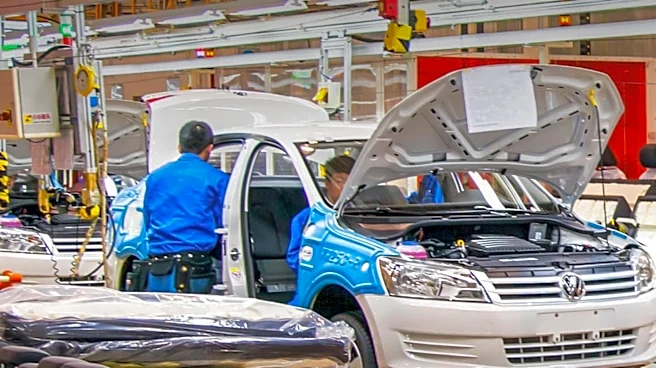
8.877 trillion VND. Following this change, VFTP's charter capital now stands at over 85.609 trillion VND, entirely composed of domestic private capital. This restructuring follows a plan announced by VinFast in May. As part of the reorganization, a portion of VFTP's assets and operations were separated to establish VinFast Vietnam Joint Stock Company (VFVN), with a charter capital exceeding 5.183 trillion VND. VFVN will take over global research and development, intellectual property ownership, after-sales services, and business operations. VFTP will retain assets related to manufacturing activities in Vietnam, including factories in Hai Phong and Ha Tinh, and shares in VinES Green Energy Solutions Joint Stock Company. VinFast Auto subsequently transferred its remaining nearly 887.72 million common shares of VFTP to three parties for a total of approximately 13.310 trillion VND, or about 530 million USD.
Why It's Important?
This complete divestment by VinFast Auto from its Vietnamese manufacturing arm signifies a strategic shift in the company's operational and financial structure. For the U.S. market, where VinFast is listed on Nasdaq, this move could impact investor perception regarding the company's global strategy and its commitment to international markets. The separation of manufacturing (VFTP) and R&D/business operations (VFVN) could streamline VinFast's global expansion efforts, potentially making its U.S. operations more agile and focused on market-specific needs. Investors in the U.S. will be closely watching how this restructuring affects VinFast's production efficiency, cost structure, and ultimately, its profitability and stock performance. The shift to 100% domestic private capital for VFTP might also be viewed as a move to consolidate local control over manufacturing, while VinFast Auto focuses on its international brand and sales. This could influence supply chain stability and production capabilities for vehicles destined for the U.S. market.
What's Next?
Following the restructuring, VFTP will continue to manufacture VinFast-branded vehicles under contract, adhering to designs, technical specifications, and standards provided by VFVN. VFVN will hold all rights related to vehicle design, technology, and intellectual property, while VFTP will manage production. The price VFVN pays VFTP is expected to be calculated using a cost-plus profit margin method, provisionally set at 105% of the cost of each vehicle. The three entities that acquired VinFast Auto's shares in VFTP are Future Investment and Development Research Joint Stock Company (49% voting rights), Ngoc Quy Trading and Investment Development Co., Ltd. (46.5%), and Mr. Pham Nhat Vuong (4.4%), with other shareholders holding the remaining 0.1%. This new ownership structure for VFTP will likely influence its operational decisions and strategic direction, which could indirectly affect VinFast Auto's ability to meet global demand, including in the U.S. market. The market will be observing how this new operational model impacts VinFast's ability to scale production and deliver on its international ambitions.
Beyond the Headlines
The restructuring of VinFast's operations, particularly the separation of its manufacturing and R&D/business functions, highlights a broader trend among global automotive companies to optimize their supply chains and intellectual property management. By centralizing R&D and intellectual property under VFVN, VinFast Auto aims to protect its core innovations while potentially allowing VFTP to operate as a dedicated, efficient manufacturing hub. This model could offer greater flexibility in adapting to different market demands and regulatory environments, especially as VinFast expands its presence in the U.S. The move also underscores the increasing importance of intellectual property in the competitive electric vehicle market. Furthermore, the complete domestic ownership of VFTP could strengthen local ties and potentially mitigate certain geopolitical risks associated with foreign ownership in critical manufacturing sectors. This strategic realignment could serve as a blueprint for other companies looking to balance global reach with localized production and innovation strategies.