





What's Happening?
The San Francisco Opera has revived its 2019 production of Mozart's 'The Marriage of Figaro,' originally conceived by the late Michael Cavanagh. This rendition reimagines the opera within an American historical context, specifically set just after the American Revolution.
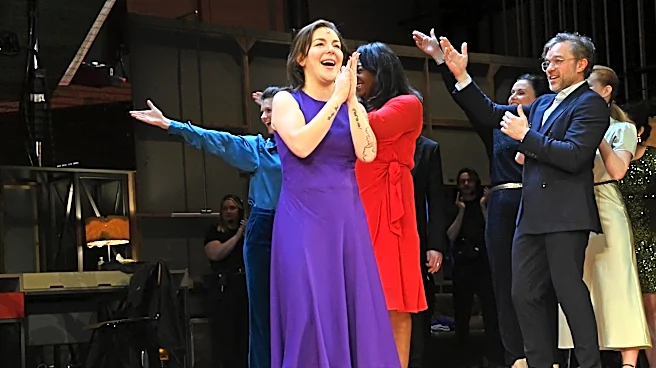
The production features set designs by Erhard Rom, depicting an unfinished federal-style neoclassical estate in a mid-Atlantic state, symbolizing a nascent republic. Costume designer Constance Hoffman incorporates red, white, and blue motifs without overt patriotism. Shawna Lucey serves as the revival director, with Sebastian Weigle making his house debut as conductor. The cast includes Slávka Zámečníková as Susanna, Peter Kellner as Figaro, Olivia Smith as the Countess Almaviva, Thomas Mole as Count Almaviva, and Simone McIntosh as Cherubino. The production aims to draw parallels between the opera's themes of privilege and social critique with American history, though some critics note the Americanization feels superficial.
Why It's Important?
This revival is significant for its attempt to connect a classic European opera with American historical narratives, potentially making its themes of class struggle and privilege more resonant for a U.S. audience. By setting the opera post-American Revolution, it invites viewers to consider how societal hierarchies persisted even after a foundational shift in governance. The production's artistic choices, such as the unfinished estate, offer a visual metaphor for the ongoing development and inherent contradictions within a new nation. For the San Francisco Opera, it represents a continuation of a thematic approach to Mozart's works, aiming to explore their relevance across different historical and cultural backdrops. The performances of emerging talents and the debut of a new conductor also highlight the company's commitment to artistic evolution and showcasing new interpretations of established works.
What's Next?
The San Francisco Opera's production of 'The Marriage of Figaro' will continue its run, allowing audiences to experience this unique American-themed interpretation. The critical reception, which notes both strengths and areas for improvement in the directorial choices and individual performances, will likely inform future productions and revivals. The company may assess audience engagement and critical feedback to refine its approach to recontextualizing classic operas. For the artists involved, particularly those making house debuts or performing major roles for the first time with the company, this production serves as a significant platform for their careers. The ongoing discussion around the effectiveness of transplanting European narratives into American settings will also likely continue within operatic circles, influencing future artistic decisions in the U.S. opera scene.
Beyond the Headlines
The production's choice to set 'The Marriage of Figaro' in post-Revolutionary America subtly raises questions about the enduring nature of privilege and class structures, even in societies founded on principles of equality. While the American Revolution aimed to dismantle aristocratic rule, the opera's themes suggest that power dynamics can persist in new forms. This interpretation encourages a deeper reflection on the ideals versus the realities of American society throughout its history. Ethically, it prompts consideration of how art can be used to critique or comment on societal issues across different eras. The production also highlights the ongoing challenge for opera companies to make classic works relevant to contemporary audiences, balancing traditional artistic integrity with innovative interpretations that resonate with modern social and political contexts. This approach can spark broader cultural conversations about historical revisionism and the universal applicability of artistic narratives.