






What's Happening?
Kubota Tractor Corporation and Agtonomy, an agricultural autonomy software company, are expanding their self-driving tractor technology to the Kubota M5 Low Profile (M5L) diesel tractor. This initiative specifically targets orchard and nut growers, including
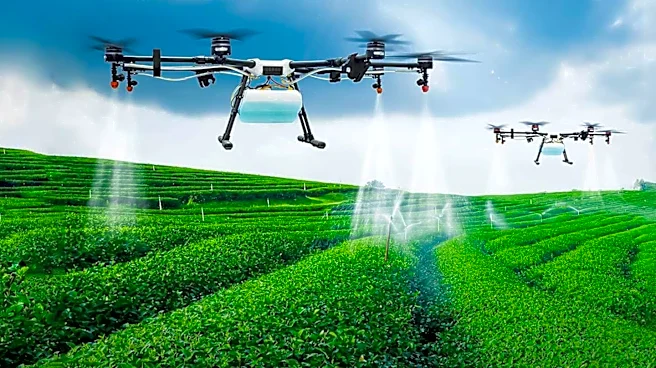
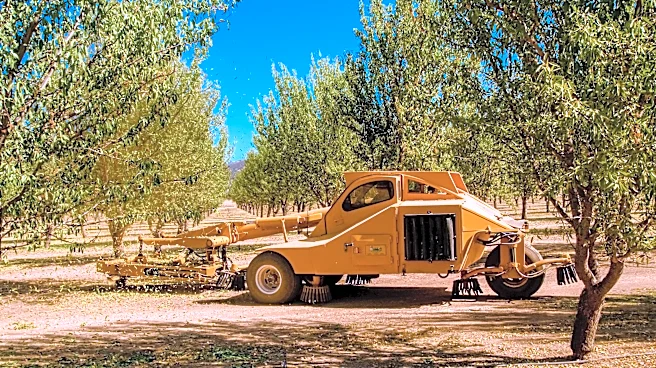
those cultivating almonds, walnuts, and apples. The M5L was selected for its lower profile and higher lift capacity, enabling it to perform tasks under tree canopies and between closely spaced rows, such as spraying, mowing, and cultivation. Agtonomy's system integrates cameras, sensors, drive-by-wire controls, and an onboard computer to convert conventional tractors into autonomous units. A single operator can manage multiple autonomous tractors, and the system includes obstacle detection for safety. This expansion follows a successful program with the narrower Kubota M5N model, which has shown significant savings and yield improvements for early adopters like Okanagan Specialty Fruits.
Why It's Important?
This expansion of autonomous tractor technology holds significant importance for the U.S. agricultural sector, particularly for specialty-crop growers who have historically received less attention from autonomous farming developers. The technology addresses critical challenges such as labor shortages and rising input costs by automating tasks like spraying, mowing, and fertilizing. Joel Carter, orchard operations manager at Okanagan Specialty Fruits, reported annual savings of approximately $2,000 per acre and yield or quality gains of 25 to 40 percent using the predecessor M5N program. The ability to run machines for 70 to 75 hours a week without additional overtime labor costs directly impacts profitability for growers. By offering autonomy as an add-on to existing diesel tractors through established dealer networks, Kubota and Agtonomy provide a cost-effective solution that avoids new equipment purchases and recharging downtime associated with electric platforms, making advanced technology more accessible to a broader range of farmers.
What's Next?
Autonomous M5L units are anticipated to be available to growers in early 2027 through Kubota's existing dealer network. This commercialization effort aims to further integrate self-driving technology into specialty-crop farming operations. The companies plan to continue developing and refining the autonomy systems, potentially expanding their application to other agricultural tasks and crop types. The success of early adopters like Okanagan Specialty Fruits, with reported substantial savings and yield increases, is expected to drive further adoption among orchard and nut growers. As the technology matures, there may be increased demand for skilled technicians capable of maintaining and troubleshooting these advanced agricultural machines, potentially leading to new job opportunities in the ag-tech support sector. The ongoing development will likely focus on enhancing the system's ability to navigate complex environments and perform a wider array of precision farming tasks.
Beyond the Headlines
The increasing adoption of autonomous agricultural machinery, as exemplified by Kubota and Agtonomy's partnership, signals a broader shift towards automation in farming. This trend could lead to significant long-term implications for the agricultural workforce, potentially reducing the demand for manual labor in certain tasks while increasing the need for technical skills in operating and maintaining advanced systems. Ethically, the widespread use of autonomous vehicles in agriculture raises questions about data privacy, as these machines collect vast amounts of information about farm operations. Furthermore, the environmental impact of precision agriculture, enabled by these technologies, could be substantial, leading to more efficient resource use and reduced chemical application. The development also highlights the growing convergence of traditional manufacturing with advanced software and artificial intelligence, transforming the landscape of agricultural equipment and practices. This technological evolution could redefine the economic viability of small to medium-sized farms by offering tools to compete with larger operations through increased efficiency and reduced operational costs.