




What's Happening?
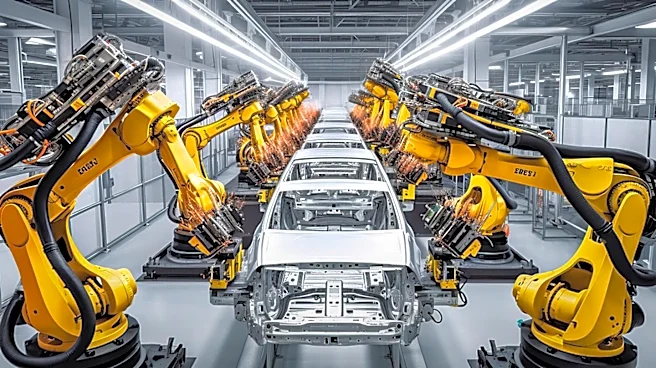
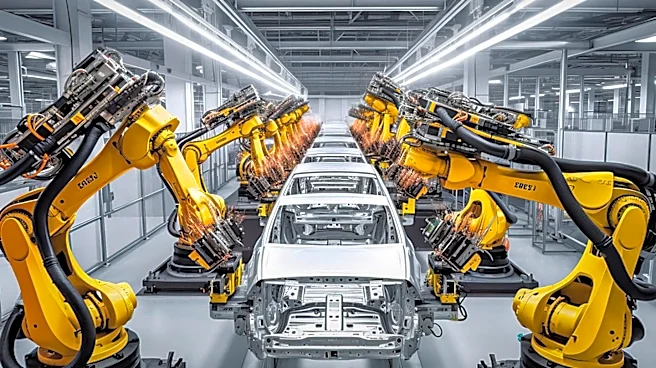
Hadrian, a company focused on advanced manufacturing, is significantly expanding its operations by building autonomous factories across the United States. The company aims to reindustrialize America by combining AI, advanced software, robotics, and full-stack
manufacturing to produce critical systems for aerospace and defense industries. This expansion follows a substantial $1.37 billion Series D funding round, valuing the company at $7.87 billion. Hadrian's goal is to enable aerospace and defense companies to build rockets, satellites, aircraft, and ships up to ten times faster and at significantly lower costs. The company is launching new capabilities in areas such as welding, casting, forging, electronics, and additive manufacturing, while also scaling its 'Factory-as-a-Service' platform. This initiative is supported by leading investors including JPMorgan Chase, Valor Equity Partners, Andreessen Horowitz, and Morgan Stanley.
Why It's Important?
This expansion by Hadrian is crucial for bolstering the U.S. aerospace and defense sectors, which are vital for national security and economic stability. By accelerating manufacturing processes and reducing costs, Hadrian's autonomous factories can enhance the competitiveness of American industries on a global scale. The 'reindustrialization of America' through advanced technology could lead to the creation of numerous high-skilled manufacturing jobs, contributing to economic growth and reducing reliance on foreign supply chains. This development also signifies a broader shift towards integrating AI and robotics into traditional manufacturing, potentially setting new industry standards for efficiency and innovation. The investment from major financial institutions underscores the perceived strategic importance and economic potential of this technological advancement in manufacturing.
What's Next?
Hadrian is actively recruiting for roles such as Technical Program Manager, Manufacturing Capabilities, to manage the launch and scaling of these new manufacturing capabilities. These roles will coordinate various teams, including software, automation, infrastructure, engineering, and quality, to ensure the successful standup of new facilities. The company plans to continue expanding its manufacturing footprint and integrating new technologies to meet the demands of aerospace and defense manufacturers. The focus will be on defining readiness criteria, tracing requirements, managing dependencies, and establishing a robust technical program management function. This ongoing development is expected to transform how critical products are built in the U.S., with a continuous effort to optimize processes and reduce production timelines.
Beyond the Headlines
The rise of autonomous factories, as spearheaded by Hadrian, represents a significant paradigm shift in manufacturing. Beyond the immediate economic and defense implications, this trend raises important questions about the future of labor, the ethical considerations of AI and robotics in industrial settings, and the long-term impact on skilled trades. While it promises increased efficiency and cost reduction, it also necessitates a re-evaluation of workforce training and education to adapt to these advanced technological environments. The 'Factory-as-a-Service' model could democratize access to high-tech manufacturing capabilities, potentially fostering innovation among smaller enterprises and startups in the aerospace and defense sectors. This technological evolution could also lead to enhanced supply chain resilience, a critical factor in an increasingly volatile global landscape.