






What's Happening?
Alphabet's autonomous driving unit, Waymo, has unveiled custom-designed 5-nanometer AI chips to power its next-generation robotaxis. These application-specific integrated circuits (ASICs), manufactured by Taiwan Semiconductor Manufacturing Co., are specifically
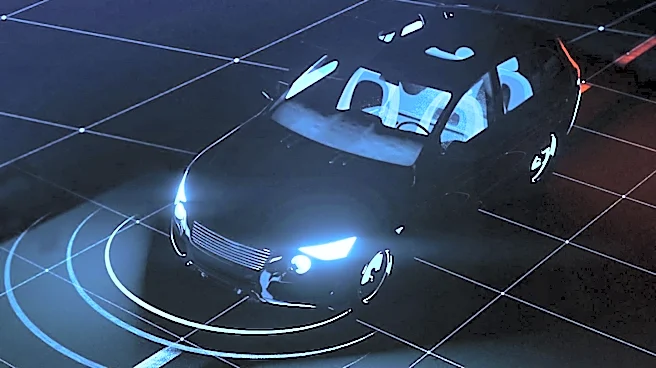
engineered to process vast amounts of raw sensor data before it is fed into the core driving system. The custom silicon focuses on the edge ingestion layer, cleaning signals, performing temporal denoising for low-light conditions, and conducting sensor fusion across 13 high-resolution cameras, four lidars, and radar feeds. Collectively, these ASICs deliver over 1,000 trillion operations per second (TOPS) of machine-learning compute. Waymo emphasizes that its onboard computing system is built for responsiveness, ruggedness, and redundancy, capable of withstanding extreme conditions and operating with parallel processing for safety. This move signifies Waymo's first public disclosure of the hardware platform within its driverless vehicles.
Why It's Important?
Waymo's development of custom AI chips is a significant step in the autonomous driving industry. By designing its own silicon, Waymo can precisely tune the hardware to meet the specific demands of autonomous driving, including critical factors like latency, power consumption, redundancy, and sensor processing. This tailored approach allows for optimized performance and efficiency, which are crucial for the safety and reliability of robotaxis operating in complex real-world environments. For enterprise technology leaders, this trend indicates that specialized AI workloads are increasingly pushing companies to control more of their computing stack, moving beyond reliance on off-the-shelf processors. The ability to customize hardware for specific AI applications can provide a competitive advantage, enhancing performance and potentially reducing costs at scale. As Waymo expands its commercial services in cities like Phoenix, San Francisco, and Los Angeles, the efficiency and reliability gains from these custom chips will be vital for scaling its operations.
What's Next?
The custom silicon is already entering production in the Ojai, Waymo's purpose-built passenger vehicle developed with Geely-owned Zeekr. As Waymo continues to expand its commercial robotaxi services, which currently conduct approximately 500,000 paid trips weekly, these custom chips are expected to play a crucial role in improving the efficiency and reliability of its fleet. The company is adopting a hybrid computing architecture, combining its custom ML-primary ASICs with best-in-class CPUs, GPUs, and accelerators for non-ML tasks, indicating a balanced approach to hardware integration. This strategy suggests that while specialized hardware is key for core AI functions, off-the-shelf components still have a place in managing broader system operations. The success and scalability of Waymo's custom silicon will likely influence other players in the autonomous vehicle industry, potentially accelerating a broader shift towards specialized hardware solutions for AI-driven applications.
Beyond the Headlines
Waymo's investment in custom silicon highlights a broader industry shift towards vertical integration in AI development. As AI workloads become more specialized and demanding, companies are finding that generic hardware solutions may not suffice. This trend extends beyond autonomous vehicles to other AI-intensive fields, where optimizing hardware for specific algorithms and data types can yield significant performance and efficiency gains. The decision to design custom chips also reflects a strategic move to gain greater control over the entire technology stack, from software to hardware, which can enhance security, reduce dependencies on external suppliers, and accelerate innovation. However, this approach also entails substantial upfront investment in research, development, and manufacturing. The success of Waymo's custom chips will not only impact the future of robotaxis but also serve as a case study for how other industries might adopt similar strategies to unlock the full potential of AI, particularly in applications where milliseconds matter and system failures carry severe consequences.