
What's Happening?
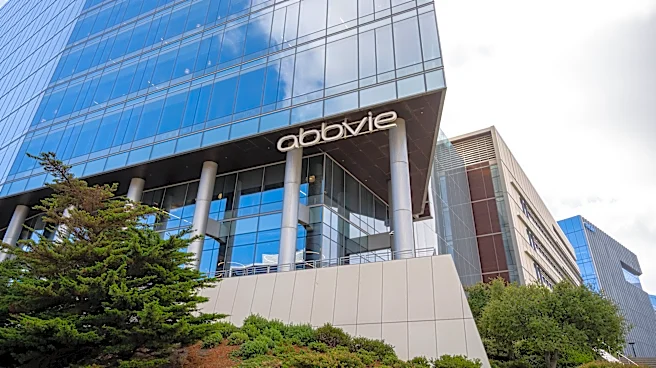
AbbVie Inc. (ABBV) is successfully navigating the patent expiration of its former top-selling drug, Humira, through the strong performance of its newer immunology medicines, Skyrizi and Rinvoq. These two
drugs, approved for various inflammatory conditions, are now growing faster than Humira's sales are declining. In the first nine months of 2026, Skyrizi generated $15.8 billion in revenue, a 25.6% increase year-over-year, while Rinvoq brought in $7.4 billion, up 23.9%. Combined, their revenue has surpassed Humira's peak annual sales. Management has raised full-year guidance for Skyrizi to $21.8 billion and for Rinvoq to $10.3 billion. Meanwhile, Humira's third-quarter sales fell 30.6% operationally to $683 million due to biosimilar competition. This successful transition has led to a roughly 20% increase in AbbVie's stock since early August, reaching $300.28 in late November.
Why It's Important?
This development is crucial for the biopharmaceutical industry, demonstrating a successful strategy for companies facing patent cliffs on blockbuster drugs. AbbVie's ability to replace lost revenue from Humira with Skyrizi and Rinvoq provides a model for other pharmaceutical companies grappling with similar challenges. The strong growth of these new drugs, coupled with the expansion into neuroscience, indicates a diversified and robust pipeline, which is vital for sustained long-term growth in the highly competitive pharmaceutical market. The company's consistent dividend increases, qualifying it as a Dividend King, also highlight its financial stability and commitment to shareholder returns, making it an attractive investment in the healthcare sector. The outperformance of Skyrizi and Rinvoq underscores the importance of continuous innovation and strategic product development in maintaining market leadership.
What's Next?
AbbVie is scheduled to release its fourth-quarter results on February 3, which will provide further insight into the continued performance of Skyrizi and Rinvoq against Humira's decline. The company anticipates additional growth from Skyrizi with its FDA approval for subcutaneous induction in Crohn's disease, expected to accelerate market share gains from early 2027. Rinvoq is also awaiting U.S. approvals for vitiligo and alopecia areata in the coming months, which could further boost its revenue. Beyond existing products, AbbVie is investing in investigational medicines like Zumilokibart for eczema and ABBV-295, a long-acting weight-loss drug. These pipeline candidates target significant and growing markets, with the eczema market potentially reaching $46 billion by 2034 and the weight-loss market an estimated $150 billion by 2035, indicating future growth avenues for the company.
Beyond the Headlines
The successful transition from Humira highlights a broader trend in the pharmaceutical industry: the increasing reliance on specialized, high-value biologics and the strategic importance of pipeline diversification. AbbVie's proactive approach to developing new immunology treatments before Humira's patent expiration allowed it to mitigate the financial impact of biosimilar competition. This strategy also underscores the significant investment in research and development required to maintain a competitive edge and address unmet medical needs. The company's focus on convenience, such as the twice-a-year dosing schedule for Zumilokibart, reflects a growing emphasis on patient-centric drug development, which can significantly influence market adoption and patient adherence. The expansion into neuroscience and the pursuit of weight-loss medications demonstrate a strategic move to tap into emerging and lucrative therapeutic areas, diversifying its revenue streams beyond immunology.