






What's Happening?
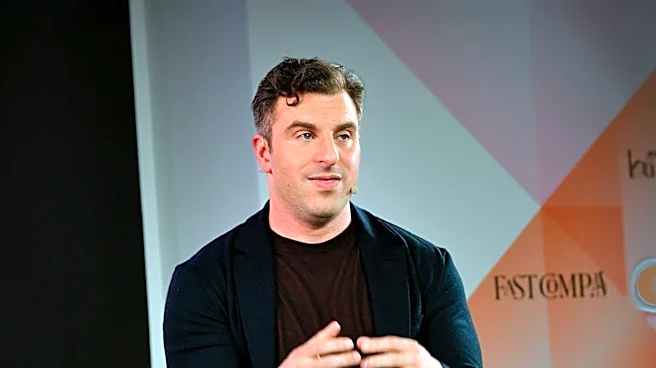
Airbnb co-founder and CEO Brian Chesky has issued a warning that managers whose sole function is to oversee people, and employees unwilling to adapt to artificial intelligence, risk becoming obsolete in the evolving workplace. Speaking on the 'Invest
Like the Best' podcast, Chesky emphasized that professionals must combine practical contributions with the ability to effectively utilize AI tools. He argued that managers need to deeply understand the work their teams produce, moving beyond reliance on meetings and routine check-ins. Chesky believes that future successful leaders will integrate people management with direct project contributions, citing former Apple chief design officer Jony Ive as an example of this hybrid approach. He clarified that his warning is not about immediate job loss for those unfamiliar with AI, but rather a call for employees to embrace continuous evolution as businesses increasingly adopt new technologies. This perspective aligns with a broader industry discussion among tech executives about the changing nature of work in an AI-driven landscape.
Why It's Important?
Chesky's statements are significant for the U.S. business landscape as they highlight a fundamental shift in corporate expectations and management structures driven by AI. His emphasis on 'hybrid managers' who are both leaders and individual contributors suggests a potential flattening of organizational hierarchies, which could impact middle management roles across various industries. Companies may re-evaluate positions that primarily involve coordination and administrative oversight, favoring those who can directly engage with and enhance productivity through AI tools. This shift could lead to a demand for new skill sets, prioritizing adaptability, technical literacy, and hands-on problem-solving. For employees, the message underscores the critical need for continuous learning and a 'growth mindset' to remain competitive. Businesses that fail to foster this adaptability among their workforce risk falling behind, while those that successfully integrate AI and upskill their employees could gain a significant competitive advantage in efficiency and innovation. The implications extend to talent acquisition, training programs, and overall corporate strategy in the coming years.
What's Next?
In response to the anticipated changes, companies are likely to initiate or accelerate efforts to redesign job roles and organizational structures. This could involve implementing new training programs focused on AI literacy and tool proficiency for both managers and individual contributors. Businesses may also re-evaluate their hiring criteria, prioritizing candidates who demonstrate a willingness to learn and adapt to new technologies. Airbnb, for instance, is already pushing its employees to use AI tools before undertaking a 'fundamental redesign' of its organizational chart, with Chesky expecting fewer management layers. Other tech leaders, such as Coinbase CEO Brian Armstrong and Block CEO Jack Dorsey, have also advocated for flatter management structures and 'player-coach' roles. This trend suggests a future where performance metrics might increasingly include an employee's ability to leverage AI for practical contributions, potentially leading to a redefinition of career progression and leadership development within organizations. The focus will be on how effectively human intelligence can collaborate with artificial intelligence to drive innovation and efficiency.
Beyond the Headlines
The deeper implications of Chesky's remarks touch upon the evolving social contract between employers and employees in the age of AI. The concept of a 'pure people manager' becoming obsolete raises questions about the value placed on traditional leadership skills like mentorship, team building, and emotional intelligence, if not directly tied to technical output. This could lead to a re-evaluation of what constitutes effective leadership and whether human-centric management aspects might be undervalued in a productivity-driven, AI-integrated environment. Furthermore, the call for employees to be 'rigid and not want to change and evolve' highlights a potential ethical dilemma: how much responsibility do companies bear in providing the necessary training and resources for adaptation, versus placing the onus entirely on individual workers? This shift could exacerbate existing inequalities if access to AI education and upskilling opportunities is not equitable. Ultimately, the integration of AI into the workplace is not just a technological change but a cultural one, demanding a redefinition of roles, responsibilities, and the very nature of human contribution in a technologically advanced society.