






What's Happening?
Rocket Lab (RKLB) experienced a significant stock decline, closing at $45.44 on Friday, November 20, marking a 10.79% drop for the day and a 22.9% loss over six trading days. This downturn wiped out approximately $9.9 billion in market value, placing
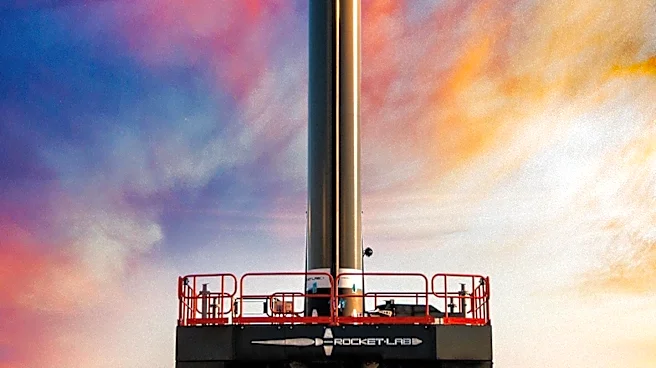
the stock roughly 70% below its 52-week high. The decline occurred amidst a broader retreat in AI and tech stocks, with the Nasdaq-100 tracker QQQ down over 5% and the S&P 500 tracker SPY down over 3% on the same day. A primary factor contributing to Rocket Lab's steeper fall is the announced delay of its Neutron rocket's inaugural launch, now projected for no earlier than 2027. This marks the second delay for the Neutron, attributed to manufacturing issues, specifically voids found in the carbon-composite dome of the first-stage propellant tank. Despite these setbacks, Rocket Lab reported strong Q3 revenue of $268 million, a 73% increase year-over-year, and a backlog that grew 52% to $3.57 billion. The company also secured over $515 million in new Neutron launch deals, increasing its manifest to 16 missions and raising its base price per mission to $70 million.
Why It's Important?
The stock performance of Rocket Lab highlights the market's sensitivity to development timelines in the high-stakes space industry, particularly for companies with ambitious projects like the Neutron rocket. While the company's current business, including Electron launches and spacecraft manufacturing, shows robust growth and a substantial backlog, investor valuation appears heavily tied to the future success and timely deployment of the Neutron. The delay, stemming from manufacturing challenges, underscores the inherent technical risks in developing advanced aerospace technology. This situation could influence investor confidence in other emerging space companies, prompting closer scrutiny of their development schedules and technical hurdles. For customers, the increased price per Neutron mission, despite the delays, suggests a limited number of alternatives with available launch slots, indicating a strong demand for reliable launch services in the satellite constellation market. However, the company's adjusted loss of $0.12 per share and projected Q4 EBITDA loss indicate that profitability remains a challenge, even with growing revenue and backlog, which could impact its long-term financial stability and ability to fund future innovations.
What's Next?
Rocket Lab's immediate focus will likely be on resolving the manufacturing issues with the Neutron rocket's first-stage propellant tank. The company has indicated that the completion of stage one assembly and tank testing is now scheduled for the first quarter of 2027, and a firmer launch date will be provided as testing progresses. Investors will be closely monitoring these technical milestones, as the market's perception of the stock is heavily influenced by the Neutron's development. The company's Q4 revenue guidance, projected between $270 million and $290 million, will also be a key indicator of its continued operational growth. Furthermore, Rocket Lab will need to demonstrate progress towards profitability, as its current valuation, even after the stock drop, remains high relative to its operating losses. The ability to convert its substantial backlog into profitable revenue will be crucial for sustaining investor confidence and funding future research and development efforts. Any further delays or technical setbacks with the Neutron could lead to additional stock volatility and increased pressure from investors.
Beyond the Headlines
The situation at Rocket Lab reflects a broader trend in the commercial space sector where ambitious technological advancements are met with significant financial and engineering challenges. The market's reaction to the Neutron delay underscores the 'perfection premium' often attached to high-growth tech and space stocks, where any deviation from projected timelines can lead to sharp corrections. This highlights the delicate balance between innovation and execution in an industry that demands both. Ethically, the company faces the challenge of transparently communicating development hurdles to investors while maintaining confidence in its long-term vision. The repeated delays tied to the same component (the propellant tank) suggest a deeper engineering or quality control issue that, if not thoroughly addressed, could impact the company's reputation and future project timelines. This scenario also raises questions about the sustainability of high valuations for companies that are still in the heavy investment phase of their most critical projects, especially when profitability remains elusive. The long-term implications could include a more cautious approach from investors towards early-stage space ventures, demanding clearer roadmaps and more robust risk mitigation strategies.