


What's Happening?
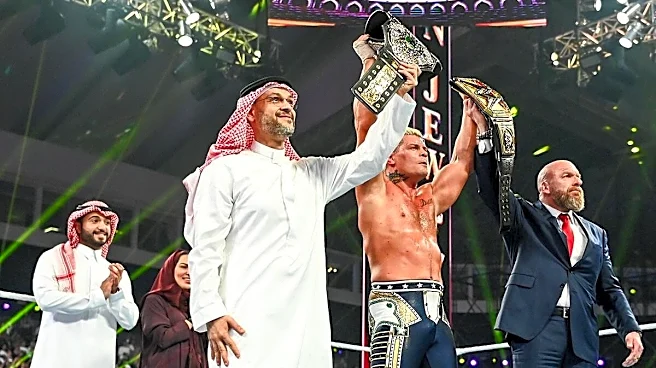
Questions have arisen regarding the attendance of Nick Khan, President of WWE, at the upcoming Crown Jewel event in Saudi Arabia. While TKO executives Ari Emanuel and Mark Shapiro are not expected to attend due to their broader responsibilities beyond
WWE, the expectation is that Khan, as the head of WWE, should be present. This sentiment is based on the principle that if he is sending his personnel into a potentially risky environment, he should accompany them. The discussion also touched upon whether Vince McMahon, under his previous ownership, would have canceled such an event, with the conclusion being that he would likely have proceeded, given his past actions.
Why It's Important?
The presence of top leadership at international events, especially those in regions perceived as having elevated risks, carries significant symbolic and practical importance. For WWE, Nick Khan's attendance at Crown Jewel would signal strong leadership and solidarity with his talent and crew. His absence, conversely, could be interpreted as a detachment from the operational realities and potential dangers faced by his employees. This situation highlights the evolving leadership dynamics within WWE following its merger into TKO, and how new executives navigate established traditions and expectations within the wrestling industry. The decision also reflects on the company's commitment to its international ventures and the perceived value of its global partnerships.
What's Next?
The immediate next step will be to observe whether Nick Khan attends the Crown Jewel event in Saudi Arabia. His decision will likely be scrutinized by fans, industry insiders, and potentially the WWE talent themselves. This event could set a precedent for how TKO's leadership approaches future international engagements for WWE. The broader implications involve how the new corporate structure balances the safety and morale of its personnel with its business objectives and contractual obligations in various global markets. The outcome could influence future travel policies and the public perception of WWE's leadership under TKO.
Beyond the Headlines
This situation subtly underscores the unique nature of the professional wrestling business, where international tours and events in diverse geopolitical landscapes are common. Unlike many corporate environments, the 'danger' referenced is not just hypothetical but can involve logistical challenges, cultural sensitivities, and security considerations. The expectation for Khan to attend reflects a traditional, almost familial, aspect of the wrestling industry where leaders are often expected to be 'in the trenches' with their performers. This contrasts with a more detached corporate approach, highlighting a potential cultural clash or adaptation period as WWE integrates into the larger TKO enterprise. The discussion also implicitly touches on the legacy of Vince McMahon's hands-on, often controversial, leadership style.