



What's Happening?
BMW has introduced its first electric sedan manufactured in India, the i5 Long Wheelbase (LWB), specifically the eDrive 35L model. This marks the second BMW electric vehicle assembled in India, following the iX1. The i5 eDrive 35L is produced at BMW's
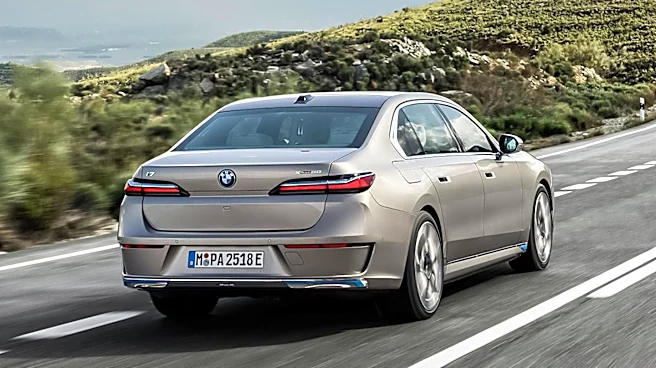
Chennai plant. India is a unique market where BMW offers the same car with different wheelbases, catering to diverse customer preferences for cabin space versus vehicle size. While the i5 eDrive 35L is locally assembled, the more powerful i5 M60, which features a standard wheelbase, is fully imported. To commemorate the launch, BMW is offering a 'First Edition' of the i5 LWB, limited to 99 units, featuring exclusive design elements like Carbon Black Metallic paint with Titanium Bronze accents and unique interior finishes. The i5 LWB is touted as the largest luxury sedan in its class, measuring 5,175 mm long with a 3,105-mm wheelbase, offering a spacious interior. It is powered by a single electric motor producing 268 hp, accelerating from 0 to 100 km/h in 6.7 seconds, and boasts a range of 416 miles (669 km) on the Modified Indian Driving Cycle (MIDC) from its 81.6-kWh battery. The Indian-made version also includes standard adaptive rear-axle suspension and increased ground clearance, features designed to suit local road conditions.
Why It's Important?
While this news primarily concerns the Indian market, it reflects BMW's global manufacturing strategy and its commitment to electric vehicle production in key international markets. For the U.S. automotive industry, this highlights the increasing decentralization of EV manufacturing and the tailoring of models to specific regional demands. The decision to produce a long-wheelbase electric sedan in India underscores the growing importance of emerging markets for luxury automakers and their EV strategies. It also demonstrates how global supply chains and manufacturing capabilities are adapting to meet diverse consumer preferences and regulatory environments worldwide. The success of such localized production can influence future investment decisions by other global automakers, potentially leading to more regionalized EV production and specialized models for different markets, which could indirectly impact the competitive landscape and product offerings in the U.S. market.
What's Next?
BMW will continue to monitor the market reception of the i5 Long Wheelbase in India, especially the limited 'First Edition' models. The company's strategy of offering both locally assembled and imported versions, along with conventionally powered alternatives like the 530Li M Sport, indicates a flexible approach to cater to various customer segments and price points. Looking ahead to 2027, the 5 Series lineup, including the i5, is slated for significant updates with the Neue Klasse design and technology, which will bring a moderate facelift and a radically different dashboard with the iDrive X system. These updates are expected to extend to the Long Wheelbase versions in 2028, ensuring the model remains competitive and technologically advanced. The ongoing evolution of BMW's EV production and market-specific offerings will be a key area to watch.
Beyond the Headlines
The introduction of the i5 Long Wheelbase in India, with its specific adaptations for local road conditions and the strategic choice of local assembly, points to a broader trend in the global automotive industry: the nuanced approach to market penetration. It's not just about selling cars, but about understanding and responding to local infrastructure, consumer preferences, and economic factors like taxation. The 'Made in India' label for an electric luxury sedan signifies a maturation of the country's automotive manufacturing capabilities and its growing role in the global EV landscape. This move also highlights the increasing importance of customization and regionalization in the luxury segment, where a 'one-size-fits-all' approach is no longer sufficient. The integration of features like increased ground clearance and adaptive suspension for challenging roads demonstrates a practical application of engineering to meet specific market needs, moving beyond mere aesthetic branding to functional adaptation.