



What's Happening?
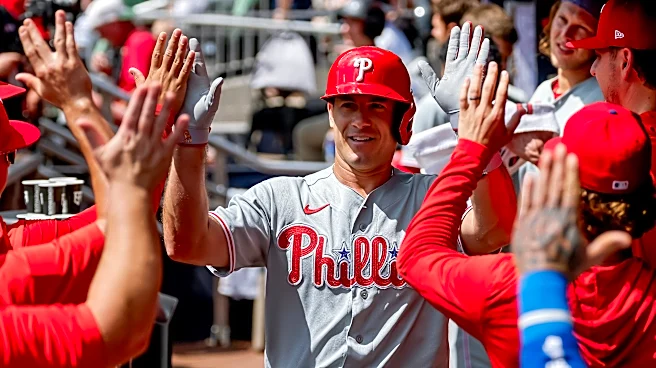
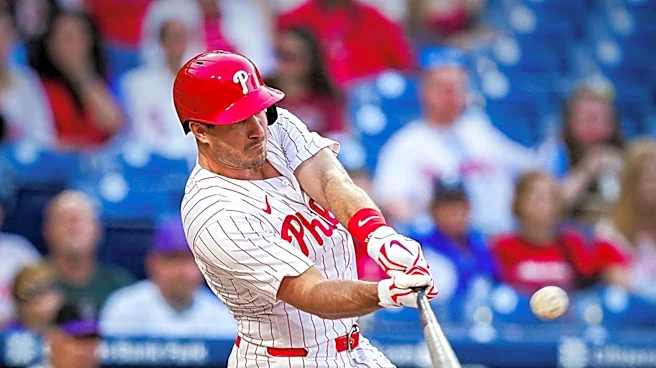
Since joining the Philadelphia Phillies at the trade deadline, Luis Arraez's individual performance has not met the high expectations set by his previous achievements, despite his positive effect on the team's lineup, particularly on Bryce Harper. Arraez is currently
batting .283 with a .673 OPS in 37 games for the Phillies, contributing 0.2 WAR according to FanGraphs. This is a notable decrease compared to his performance with the San Francisco Giants, where he hit .324 with an .801 OPS and 3.8 WAR over 105 games. While Arraez is still on pace to win his fourth career batting title with a .313 average across both teams, his production in Philadelphia has been underwhelming. His flyball percentage has increased to 45.8% with the Phillies, compared to 37.7% with the Giants and a career mark of 31.8%. Additionally, his batting average on balls in play (BABIP) has dropped to .277 as a Phillie, from .327 with the Giants, suggesting some degree of bad luck.
Why It's Important?
Luis Arraez's individual performance is crucial for the Philadelphia Phillies, especially as they navigate the Wild Card race. While his presence has positively influenced other players like Bryce Harper, the team needs more direct offensive production from him. Arraez, known as a contact hitter rather than a power hitter, relies heavily on his batting average to get on base. His current dip in performance, characterized by a lower batting average and OPS compared to his time with the Giants, could impact the Phillies' offensive consistency as they head into the playoffs. The team's success in the postseason will likely depend on key players performing at their best, and Arraez's ability to return to his previous form is a significant factor. His struggles, if prolonged, could force the Phillies to consider lineup adjustments or rely more heavily on other hitters, potentially altering their strategic approach in critical games.
What's Next?
The Philadelphia Phillies are hoping for a positive regression in Luis Arraez's performance as they continue their push in the Wild Card race. The team anticipates that his luck will turn, especially given that some metrics suggest he has been unlucky, such as an uptick in his hard-hit percentage despite a lower BABIP. Arraez is expected to continue playing a crucial role, and the Phillies will be looking for him to improve his individual production in the remaining games of the season. His ability to string together multi-hit games and get on base more consistently will be vital for the team's playoff aspirations. The focus will be on Arraez returning to his career-best contact hitting form to provide the offensive spark the Phillies need as they prepare for October baseball.
Beyond the Headlines
The disparity in Luis Arraez's performance between the San Francisco Giants and the Philadelphia Phillies highlights the subtle yet significant impact of team environment, ballpark characteristics, and coaching on a player's statistics. Arraez's higher batting average at Oracle Park and his credit to Giants infield coach Ron Washington for defensive improvements suggest that factors beyond individual skill can influence a player's output. This situation underscores the complex interplay between a player's natural abilities, the specific context of their team, and even the physical dimensions of their home stadium. For the Phillies, understanding these nuances could be key to unlocking Arraez's full potential, not just through statistical analysis but also by considering the psychological and environmental factors that might be affecting his game. This scenario also raises questions about player valuation in trades, where a player's past performance might not perfectly translate to a new setting.